Avoid these top 7 claim denials: the 2026 edition
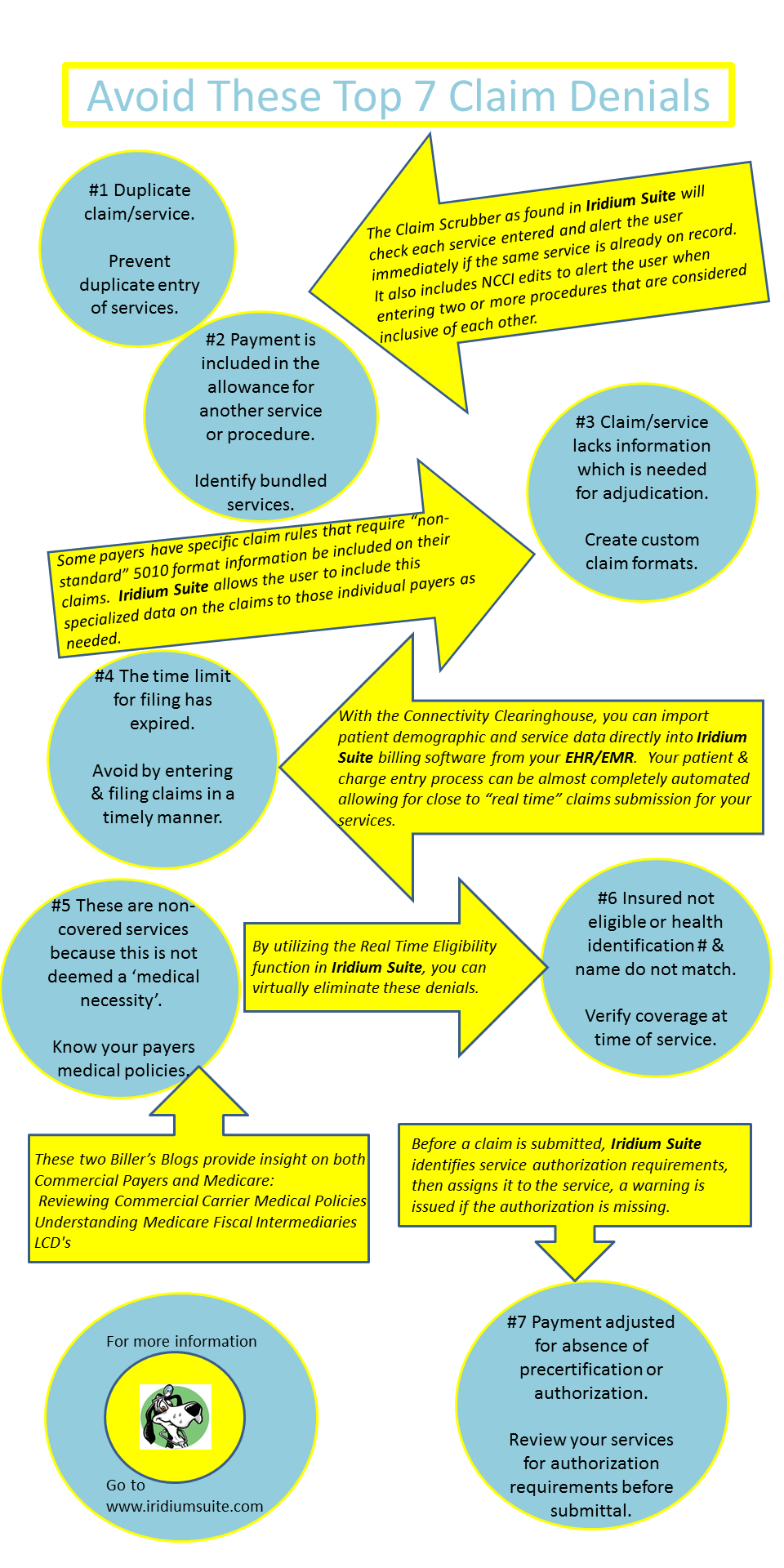
In September 2013 we published an infographic called “Avoid These Top 7 Claim Denials.” We reread it this month and did not need to change the list. The top claim denials a practice sees in 2026 are the same seven: duplicate claim, payment included in another service, claim lacks information, timely filing expired, not medically necessary, insured not eligible or ID mismatch, and no precertification or authorization. Even the reason codes are the ones we printed then; the X12 list shows the last text change to CARC 16 and CARC 197 in 2018.
What has changed is the financial pressure on practices. MGMA’s benchmarking puts first-submission denial rates at 7 to 8 percent over the past four years, and in a January 2026 MGMA Stat poll 48 percent of practice leaders named denials and appeals their largest source of revenue leakage. In MGMA’s July 28, 2026 poll of 203 leaders, 32 percent said days in A/R were higher than a year earlier, most often blaming payer behavior: slow payment, initial denials, downcoding and lengthy appeals.
Here is the 2026 version as a checklist: the codes on the 835, why each denial happens, whether to correct and resubmit or appeal, and how to prevent it. Radiation oncology practices have a specialty companion in the radiation oncology claim denials post.
The rules that apply to all seven
The Claim Adjustment Reason Code (CARC) gives the reason for the adjustment, the group code (CO, PR, OA) shows who owes the balance, and the Remittance Advice Remark Code (RARC) adds detail. CARC 16 and 96 must carry a RARC.
For Medicare, a redetermination request is due 120 days from receipt of the initial determination, presumed to be 5 calendar days after the notice date; there is no minimum amount, and the MAC generally decides within 60 days. Two denials carry no appeal rights at all: an exact duplicate, which the Claims Processing Manual says is controlled by hard-coded edits that contractors cannot override, and a claim returned as unprocessable (RARC MA130), which “is not denied, and, as such, is not afforded appeal rights.” Those two are corrected and resubmitted, never appealed.
| Denial | CARC | Typical RARC | Usual response | |
|---|---|---|---|---|
| 1 | Duplicate claim | 18 (group OA) | M86, M80 | Check status; do not rebill |
| 2 | Payment included in another service | 97, 234 | M15, N19, M144 | Accept, or modifier and resubmit |
| 3 | Claim lacks information | 16 | MA130, M51, M53, M76, M77, N382, N822 | Correct and resubmit |
| 4 | Timely filing expired | 29 | Often none | Appeal only with proof; otherwise write off |
| 5 | Not medically necessary | 50 | N115, N130 | Appeal with the record |
| 6 | Insured not eligible or ID mismatch | 31, 27, 140, 109 | N382, N30 | Verify and bill the right payer |
| 7 | No precertification or authorization | 197, 198 | N54, N351, N640 | Correct the line or appeal with the approval |
1. Duplicate claim
Codes. CARC 18, “Exact duplicate claim/service,” group OA; RARC M86 (payment already made for the same procedure) or M80 (same session or date as a processed service).
Why. A claim is rebilled before the first one posts, a correction goes out as a new claim instead of a replacement, or two lines of one code on one date lack the modifier that marks the second as distinct.
Fix. Nothing to appeal. Check the original claim: if it paid, post it; if it denied, work that denial. A real second service is resubmitted with the distinguishing modifier.
Prevent. Check status before rebilling and send corrections as replacement claims. Iridium Suite’s claim scrubber flags a service already on record for the same patient and date before it is denied as CARC 18.
2. Payment included in another service
Codes. CARC 97, “The benefit for this service is included in the payment/allowance for another service/procedure that has already been adjudicated,” or 234, “This procedure is not paid separately”; RARC M15 (bundled components), N19 (incidental procedure) or M144 (pre- or postoperative care).
Why. An NCCI procedure-to-procedure edit pairs the codes, the service is a component of a global procedure, or a visit falls inside a postoperative period.
Fix. Usually accept. Where the NCCI edit allows a modifier (59 or an X modifier, 25, 24) and the record shows a separate service, add it and resubmit; appeal only when the payer bundled something its own policy pays separately.
Prevent. Scrub against the current quarter’s NCCI edits, which CMS updates quarterly. The same scrubber applies the current CCI pairs at charge entry rather than weeks later on a CO-97.
3. Claim lacks information
Codes. CARC 16, “Claim/service lacks information or has submission/billing error(s),” always with a RARC naming the field: MA130 (unprocessable, no appeal rights), M51 (procedure code), M53 (units), M76 (diagnosis), M77 (place of service), N382 (patient identifier), N822 (missing modifier) or N56 (code not valid for the date of service).
Why. Keying errors, a code deleted on January 1, a missing modifier, a mismatched place of service, or a payer-specific requirement such as taxonomy.
Fix. Read the RARC, correct the field, resubmit.
Prevent. Update code sets on January 1 and each quarter, and build payer-specific edits from the RARCs you see most; payer rules in the scrubber apply only to the payer that needs them.
4. Timely filing expired
Codes. CARC 29, “The time limit for filing has expired,” usually with no RARC.
Why. Medicare claims must be filed within 12 months, or one calendar year, of the date of service (42 CFR 424.44); for professional claims with span dates the filing period starts on the line item “From” date. Commercial limits are set by contract and often shorter. A rejected or unprocessable claim does not count as filed.
Fix. Appeal only with proof of timely receipt, such as a clearinghouse acceptance report, or under a Medicare exception: administrative error by Medicare or its contractor, retroactive Medicare entitlement, or a Medicaid recoupment after retroactive entitlement. Otherwise write it off.
Prevent. Age receivables by each payer’s filing limit and work rejections the day they arrive. Iridium Suite’s Accounts Receivable queues prioritize claims with reminders so those nearing a limit are listed first.
5. Not medically necessary
Codes. CARC 50, “These are non-covered services because this is not deemed a ‘medical necessity’ by the payer”; RARC N115 when a Local Coverage Determination decided it, or N130 (consult plan benefit documents).
Why. The diagnosis does not meet the LCD or payer policy, the frequency exceeds policy, or the supporting documentation never reached the payer.
Fix. File the redetermination within 120 days with the note, the order and the policy criterion met. Watch the group code: PR shifts the balance to the patient and is only right when an Advance Beneficiary Notice was signed.
Prevent. Check coverage criteria at scheduling, code the diagnosis to the specificity the policy requires, and obtain an ABN when non-coverage is expected. Denials that still occur go to the A/R work list, sorted by group and reason code.
6. Insured not eligible or ID mismatch
Codes. CARC 31, “Patient cannot be identified as our insured”; 27 (coverage terminated); 140, “Patient/Insured health identification number and name do not match”; 109, “You must send the claim/service to the correct payer/contractor.” RARC N382 (patient identifier) or N30 (patient ineligible).
Why. Coverage changed on January 1, the patient joined a Medicare Advantage plan and still presented the Medicare card, the identifier was typed wrong, or the secondary payer was billed as primary.
Fix. Verify coverage for the date of service, correct the policy record and bill the correct payer. There is no appeal to the wrong payer, and the right payer’s filing limit still applies.
Prevent. Verify at scheduling, at check-in and again every January. Iridium Suite’s Real-Time Eligibility returns the payer’s response in seconds and can build the policy record from it, so staff do not type the identifier by hand, which is where identifier errors start.
7. No precertification or authorization
Codes. CARC 197, “Precertification/authorization/notification/pre-treatment absent,” or 198 (exceeded); RARC N54 (claim inconsistent with authorized services), N351 (date outside the approved plan dates) or N640 (exceeds approved frequency).
Why. No authorization was obtained, the service ran past the approved dates or units, or the billed code differs from the approved one.
Fix. If the approval was right and the claim wrong, correct the code, dates or units and resubmit. If the claim was right and the payer’s record wrong, appeal with the approval letter. With no authorization, request a retroactive one where allowed; otherwise appeal on medical necessity. For Medicare Advantage, Medicaid and CHIP plans, CMS-0057-F has required since January 1, 2026 a decision within 7 calendar days (72 hours expedited) and a specific reason for every denial.
Prevent. Track every authorization with its codes, units, dates and provider, and check it before the first claim. Payer-specific rules in the scrubber can carry authorization requirements by payer, so a line that needs an approval with none on file is flagged before the claim goes out.
What to do now
- Post every denial with its CARC and RARC and sort by them monthly. The top three show which processes to fix first.
- Sort denials the day the remittance posts: 16, 18, 31, 109, 140 and 29 without proof are corrected or rebilled; 50, 197 and 198 with documentation are appealed within 120 days; 97 and 234 are usually accepted.
- Verify eligibility twice, at scheduling and at check-in, and re-verify every active patient in January.
- Age A/R by payer filing limit and work rejections daily.
- Keep the infographic. The list has not changed in thirteen years.
Further reading
- X12: Claim Adjustment Reason Codes
- X12: Remittance Advice Remark Codes
- CMS: First level of appeal, redetermination by a Medicare contractor
- Medicare Claims Processing Manual, chapter 1 (PDF): section 70, timely filing; section 80.3, unprocessable claims; section 120, duplicate claims
- MGMA Stat, July 28, 2026: Days in A/R holds steady for most practices, but payer pressure persists in 2026
- CMS fact sheet: Interoperability and Prior Authorization final rule (CMS-0057-F)