Modifier Q6 and Locum Tenens Billing: Fee-for-Time Arrangements, the 60-Day Rule and Which NPI to Use
Modifier Q6 identifies a service furnished by a substitute physician under a fee-for-time compensation arrangement, which Medicare called a locum tenens arrangement until 2017. The regular physician bills under their own NPI with Q6 on each line, and the arrangement may not run longer than 60 continuous days.
Every practice needs coverage at times, for a maternity leave, a conference week or an illness. Medicare lets the regular physician bill for it, as long as the practice counts the days.
Where you see it
| Place | What you see |
|---|---|
| CMS-1500 box 24D | Q6 (or Q5) in a modifier position after the CPT or HCPCS code on every substitute line |
| 837P loop 2400 | the same modifier in SV101-3 through SV101-6 |
| CMS-1500 box 24J | the regular physician’s Type 1 NPI, not the substitute’s, on Medicare claims |
| CMS-1500 box 33a | the group’s Type 2 NPI, unchanged |
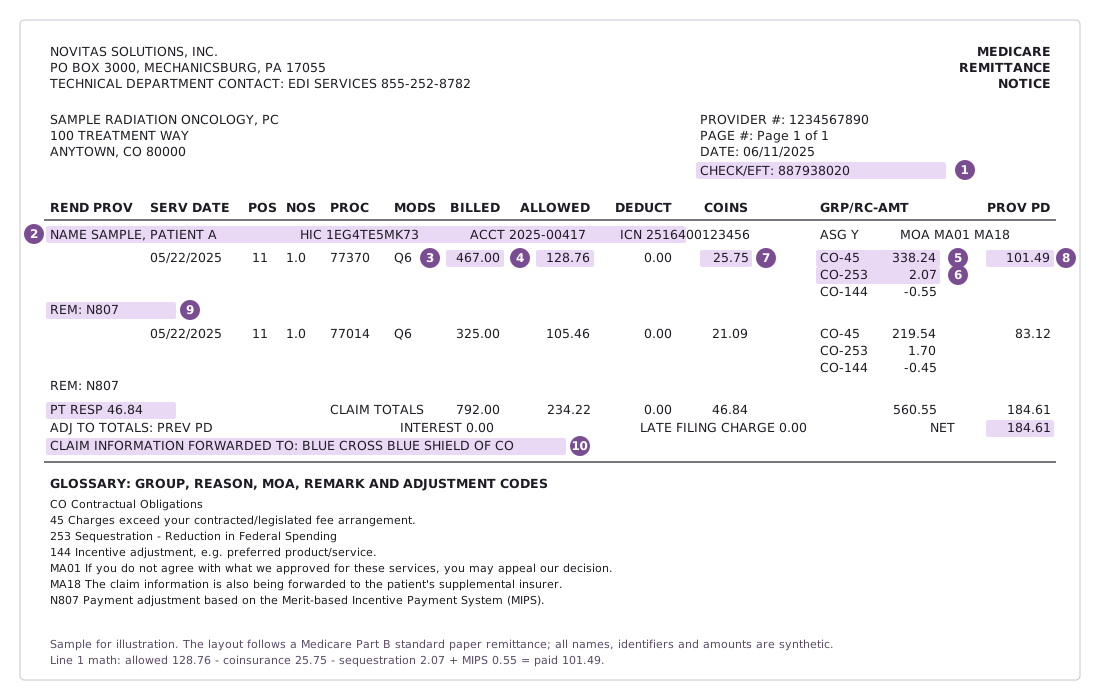
| The remittance | the modifier appears on the service line; the Q6 on our annotated remittance sample is exactly this |
| The regular physician’s file | a record of each substitute service with the substitute’s NPI, available to the MAC on request and never sent with the claim |
Q5 and Q6 side by side
| Q5: reciprocal billing | Q6: fee-for-time compensation | |
|---|---|---|
| The arrangement | physicians cover each other occasionally | the regular physician hires a substitute and pays per diem or a similar fee for time |
| Who pays the substitute | no one; the physicians cover for each other in return | the regular physician or the group |
| Whose NPI is billed | the regular physician’s | the regular physician’s |
| Written agreement | not required | not required by the manual, though the per diem arrangement should be documentable |
| 60-day limit | yes | yes |
| Record of substitute’s NPI | required | required |
The conditions are the same for both: the regular physician is unavailable, the patient arranged or sought care from the regular physician, the substitute does not exceed 60 continuous days, and the modifier is entered after the procedure code.
Why the name changed
The term locum tenens was removed from CMS’s manuals with Transmittal 3774 (Change Request 10090), issued May 12, 2017 and effective June 13, 2017. Section 16006 of the 21st Century Cures Act used “locum tenens arrangements” to mean both fee-for-time and reciprocal arrangements, so CMS stopped using it for just one of them. The same transmittal extended both arrangements to outpatient physical therapists in health professional shortage areas, medically underserved areas and rural areas. Everyone still says locum tenens in conversation, and the manual sections (30.2.10 and 30.2.11 of chapter 1) still carry the old name in parentheses.
The 60-day rule
A “continuous period of covered visit services” begins on the first day the substitute sees the regular physician’s Medicare Part B patients and ends on the last day the substitute sees them before the regular physician returns to work. The period keeps running on days when no services are furnished and on days another substitute covers. A new period can only begin after the regular physician has come back.
The manual’s own example: the regular physician leaves June 30 and returns September 4; the substitute works July 2 through September 2, a period of 63 days. The regular physician may bill, with the modifier, for July 2 through August 30. Services on August 31 through September 2 must be billed by the substitute in their own name and number, or reassigned to a group that bills for the substitute.
The one exception is a regular physician called or ordered to active duty as a member of a reserve component of the Armed Forces, who may bill beyond 60 days.
MACs do not track the 60 days on the front end. They pay Q5 and Q6 lines on the regular physician’s certification and look at the arrangement only on post-payment review, which is when a period over 60 days is found.
Who the arrangement covers
- The regular physician may be any physician, including a specialist; the manual lists an oncologist among its examples.
- Noridian’s guidance limits substitutes to physicians (MD and DO); services of nurse practitioners, physician assistants and CRNAs are not billed under these arrangements.
- A group may bill substitute services in the name of a group physician only if the substitute has not reassigned benefits to that group. The substitute’s identity goes in the record; the regular group physician’s NPI goes in 24J.
- Post-operative services inside a global period need no modifier, because the global fee already covers them.
- Outpatient physical therapists in HPSA, MUA and rural areas may use both arrangements since June 13, 2017.
Worked example
Dr. Patel, a radiation oncologist at Sample Radiation Oncology, PC, begins leave on October 1 and is due back December 15. The group hires Dr. Osei as a fee-for-time substitute at a daily rate; she sees Dr. Patel’s patients from October 6.
| Dates | Day count | Billing |
|---|---|---|
| October 6 to December 4 | days 1 to 60 | 77427 weekly management, 24J Dr. Patel’s NPI, modifier Q6, 33a the group’s NPI |
| December 5 to December 14 | days 61 to 70 | not billable under Dr. Patel; Dr. Osei must be enrolled and reassigned to the group and bill under her own NPI, or the group arranges other coverage |
Payment is the same as if Dr. Patel had furnished the service: a 77427 billed at 240.00 with an allowed amount of 180.00 pays 144.00 after the 36.00 coinsurance (illustrative). The group keeps a log for each date: patient, service, Dr. Osei’s NPI. None of that goes on the claim.
Had the practice known in September that the leave would run past 60 days, the better option would have been to start Dr. Osei’s enrollment and reassignment in PECOS right away, so that she could bill under her own NPI from day 61 without a gap. See PTAN and Medicare enrollment.
What to do
- Count from the substitute’s first day, not the regular physician’s last. Put the 60th day on a calendar when the arrangement starts.
- Bill the regular physician’s NPI with Q6 on every line for Medicare. For commercial payers, check the policy; some want the substitute credentialed instead, and the NUCC’s general instruction for 24J is to report the substitute, so follow the payer’s rule.
- Keep the record. Date, patient, service, substitute’s NPI. The Q6 is a certification that this record exists, and the manual spells out civil, criminal and administrative penalties for a false one.
- Denials to recognize: CARC B7 or CARC 185 when a substitute’s own NPI is billed before they are enrolled, and CARC 16 with RARC N290 when the rendering NPI is missing. Periods over 60 days are found on audit rather than as denials.
- Iridium Suite’s reporting can list services by rendering provider, date and modifier, which is the quickest way to count the days in a fee-for-time period and to pull the record a MAC asks for.
Related terms
- NPI numbers: Type 1 vs Type 2
- Rendering provider vs billing provider
- PTAN and Medicare enrollment
- CMS-1500 box by box
- CPT 77427 weekly treatment management
- Modifiers used in the RO Model
Further reading: Medicare Claims Processing Manual, chapter 1, sections 30.2.10 and 30.2.11; CMS Transmittal 3774 (CR 10090), May 12, 2017; Noridian: Fee-for-Time Compensation Arrangements and Reciprocal Billing.
Frequently asked
What is modifier Q6?
Modifier Q6 identifies a service furnished by a substitute physician under a fee-for-time compensation arrangement, the arrangement Medicare called locum tenens until 2017. The regular physician bills the service under their own NPI with Q6 on each line, pays the substitute on a per diem or similar basis, and keeps a record of the substitute's NPI.
What is the difference between modifier Q5 and Q6?
Q5 is for a reciprocal billing arrangement, where physicians cover for each other occasionally and nobody is paid per diem. Q6 is for a fee-for-time arrangement, where the regular physician pays a substitute for their time. Both bill under the regular physician's NPI and both are limited to 60 continuous days.
What is the 60-day rule for locum tenens?
The substitute may not provide services to the regular physician's Medicare patients over a continuous period of longer than 60 days. The period runs from the substitute's first day to the last day before the regular physician returns, and days with no services do not break it. The only exception is a regular physician called to active duty in the Armed Forces.
Whose NPI goes on a locum tenens claim?
The regular physician's NPI goes in box 24J with Q6 on the line, and the group's NPI in 33a as usual. The substitute's NPI does not go on the Medicare claim; it goes in a record the regular physician keeps and must produce on request.