CHAMPVA Cards and Billing: How to Read the Card and File the Claim
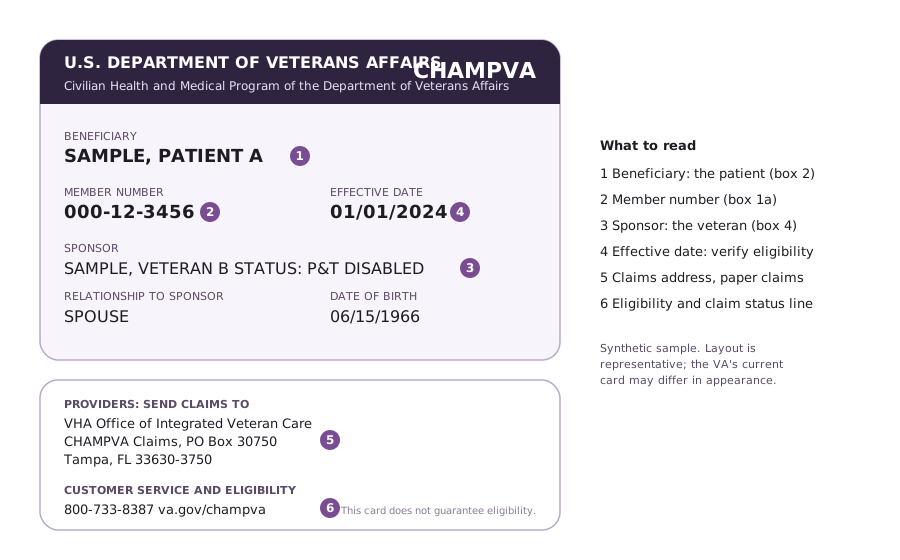
CHAMPVA (the Civilian Health and Medical Program of the Department of Veterans Affairs) is a health benefit for the spouse, surviving spouse and dependent children of a veteran who is permanently and totally disabled from a service-connected condition, or who died from one. The veteran is the sponsor; the family members are the beneficiaries, and they can be treated by any licensed provider who accepts Medicare rates, with the claim paid by the VA from Denver. It is not TRICARE, and it is not VA care; a CHAMPVA patient is a civilian with federal coverage.
Many billers see a CHAMPVA card only a few times a year and apply the TRICARE rules by mistake. The two programs look alike but work differently.
Reading the card
The CHAMPVA identification card is a plain card from the VA Office of Integrated Veteran Care (the former Office of Community Care). It is not a smart card and it does not prove current eligibility, which is why the first step is always a check.
| On the card | What it is | Where it goes on the claim |
|---|---|---|
| Beneficiary name | the patient, not the veteran | box 2 |
| Member number | the beneficiary’s own identifier (historically the sponsor’s SSN; newer cards use a VA-assigned number) | box 1a, insured’s ID |
| Sponsor name and status | the veteran whose disability or death created the eligibility | box 4 and box 11, with “CHAMPVA” as the plan |
| Effective date | when coverage began; ends at remarriage before age 55 for a spouse, or at 18 (23 if a student) for a child | eligibility check |
| Claims address | For providers: VHA Office of Integrated Veteran Care, CHAMPVA Claims, PO Box 30750, Tampa FL 33630-3750. (The Denver PO Box 469064 printed in older guides is for beneficiaries filing their own reimbursement claims.) | where the paper claim goes |
| Customer service number | 800-733-8387 | eligibility and claim status |
CHAMPVA, TRICARE and VA care are three different things
| CHAMPVA | TRICARE | VA community care | |
|---|---|---|---|
| Who is covered | family of a permanently disabled or deceased veteran | active duty, retirees and their families | the veteran, when the VA authorizes care outside its own facilities |
| Run by | Department of Veterans Affairs, centrally in Denver | Department of Defense, through regional contractors | the VA, through authorizations and a third-party administrator |
| Network | none; any Medicare-accepting provider | contracted networks by region | referral and authorization required for each episode |
| Pays | CHAMPVA allowable, tied to the Medicare fee schedule | TRICARE allowable | VA fee schedule, per the authorization |
| Patient cost share | 25 percent of the allowable after a 50.00 annual deductible per person (100.00 per family), with an annual cap of 3,000 | varies by plan | none to the veteran |
A veteran’s spouse cannot be covered by both CHAMPVA and TRICARE; if the veteran qualifies for TRICARE (for example as a military retiree), the family uses TRICARE.
Filing the claim
- Verify eligibility first. Call 800-733-8387 or use the VA’s provider portal. The card alone does not prove current coverage, and a child who turned 18 last month may no longer be covered.
- Bill every other insurance before CHAMPVA. CHAMPVA is secondary to Medicare, Medicare Advantage, employer plans and individual plans. A beneficiary over 65 must be enrolled in Medicare Part B to keep CHAMPVA. Attach the primary payer’s EOB to the CHAMPVA claim.
- Use the standard forms. CMS-1500 for professional services, UB-04 for facility. Electronic claims are accepted through clearinghouses using the CHAMPVA payer ID; your clearinghouse will have it on its payer list.
- Code normally. CPT, HCPCS, ICD-10 and modifiers as for any other payer. There are no CHAMPVA-specific codes.
- File within one year. Claims must be filed within one year of the date of service (for inpatient care, one year from discharge).
- Expect Medicare rates. CHAMPVA’s allowable is based on the Medicare fee schedule, and a provider who accepts a CHAMPVA patient accepts the allowable as payment in full apart from the cost share. You may not balance-bill.
A worked example
A CHAMPVA beneficiary, age 58 with no other insurance, has a weekly radiation treatment management visit (CPT 77427). The allowable is 190.00 (illustrative). She met her 50.00 deductible in January.
| Amount | |
|---|---|
| Allowable | 190.00 |
| Deductible applied | 0.00 (already met) |
| Patient cost share, 25 percent | 47.50 |
| CHAMPVA pays | 142.50 |
| Provider may bill the patient | 47.50 and nothing more |
If the same patient were 68 with Medicare Part B, Medicare would pay first (80 percent of its allowable), the claim would cross over or be filed to CHAMPVA with the Medicare remittance attached, and CHAMPVA would generally pay the remaining 20 percent, leaving the patient with nothing to pay. This is the main reason to confirm the patient’s Medicare status at check-in.
What to do
- Put CHAMPVA in your payer list as a secondary payer by default, with Medicare rates and the Tampa provider claims address, so the front desk does not set it up as a TRICARE plan.
- Collect the EOB from the primary before the CHAMPVA claim goes out; without it the claim is returned.
- Track the one-year limit like any other timely filing rule. Iridium Suite’s claim scrubber can hold a payer-specific timely filing rule for CHAMPVA so the claim is flagged before the deadline.
- Denials to recognize: eligibility (verify and rebill, or bill the patient if coverage had ended), other health insurance not reported (attach the primary EOB), and timely filing.
Related terms
- Secondary claims: three ways to file
- Medicare crossover claims
- Timely filing limits by payer
- Coordination of benefits
- TRICARE billing basics
Further reading: VA: CHAMPVA benefits; VA: Filing a CHAMPVA claim, with current claims addresses; VA: Information for providers.
Frequently asked
What is CHAMPVA?
The Civilian Health and Medical Program of the Department of Veterans Affairs. It covers the spouse, surviving spouse and children of a veteran who is rated permanently and totally disabled from a service-connected condition, or who died from one. The veteran is the sponsor; the family members are the beneficiaries.
Is CHAMPVA the same as TRICARE?
No. TRICARE is the Department of Defense program for active-duty and retired military families, run through regional contractors. CHAMPVA is a VA program for families of disabled or deceased veterans, administered centrally by the VA in Denver. A family cannot be eligible for both.
Does a provider have to be in a CHAMPVA network?
There is no network. Any licensed provider who accepts Medicare rates can treat a CHAMPVA beneficiary and file a claim. Accepting assignment means accepting the CHAMPVA allowable as payment in full apart from the patient's cost share.
Is CHAMPVA primary or secondary?
CHAMPVA is almost always secondary. It pays after Medicare, after any employer or private plan, and after Medicare Advantage. It is primary only when the beneficiary has no other coverage, or ahead of Medicaid and CHAMPVA supplemental plans.