Medicare Crossover Claims: How Medicare Forwards to Medigap and Medicaid, and When to Bill the Secondary Yourself
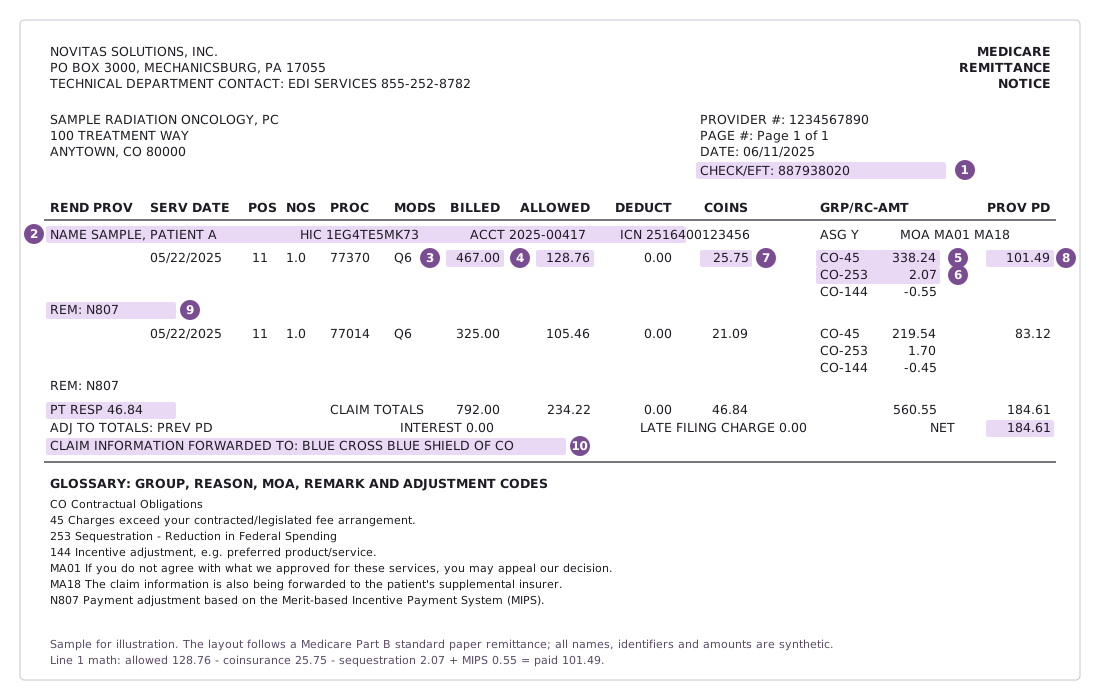
Medicare crossover claims are claims that Medicare, after adjudicating them as primary, forwards electronically to the patient’s supplemental payer (Medigap, Medicaid or an employer retiree plan) so the practice does not have to file a secondary claim. The remittance shows when it has happened.
The crossover saves the practice real work. The main task is to spot the claims that did not cross over and bill those secondaries yourself.
Where you see it
| Place | What you see |
|---|---|
| Medicare remittance (SPR), claim level | remark code MA18 or MA07 in the MOA field, and a line reading “CLAIM INFORMATION FORWARDED TO:” with the payer’s name |
| ERA (835) | the same remark codes in the MOA segment, and the crossover payer’s name and ID in the claim’s “transfer to” (crossover carrier) loop |
| CMS-1500 items 9, 9a and 9d (or 837 loops 2320 and 2330) | the Medigap policy and insurer information used by the older claim-based crossover process |
| The supplemental payer’s remittance | arrives on its own, usually two to four weeks after Medicare’s, with payment for the deductible and coinsurance Medicare left to the patient |
On the annotated remittance sample, the MOA field reads MA01 MA18 and callout 10 is the forwarding line: “CLAIM INFORMATION FORWARDED TO: BLUE CROSS BLUE SHIELD OF CO.” Both say the same thing: the 46.84 of patient responsibility on that claim has been sent to the Medigap insurer, and the patient should not be billed yet.
How the crossover works
Medicare’s crossover runs through the Coordination of Benefits Agreement (COBA) program at CMS’s Benefits Coordination & Recovery Center (BCRC), which until 2014 was called the Coordination of Benefits Contractor. The steps:
- A supplemental payer (a “trading partner”) signs a national COBA with CMS and sends the BCRC an eligibility file listing the Medicare beneficiaries it covers. The BCRC loads that information into Medicare’s Common Working File.
- Your claim is processed by the Medicare Administrative Contractor as usual.
- After the claim leaves the payment floor, the MAC sends the adjudicated claim data to the BCRC, which converts it into an 837 coordination-of-benefits claim and transmits it to the trading partner. The Medicare remittance to you carries MA18 (or MA07 for Medicaid) and the trading partner’s name.
- The trading partner calculates its secondary payment from Medicare’s allowed, paid and patient-responsibility amounts, and pays you directly.
If the claim crosses to more than one payer, only one name prints on your remittance; CMS says the Medigap insurer always prints when one is involved. Nearly all Medigap plans and nearly all state Medicaid programs participate in the eligibility-file crossover. A small number of Medigap plans (First Coast puts it at “approximately ten or eleven”) still use the older claim-based process, which depends on the Medigap information you put in item 9 of the CMS-1500 and is available only to participating providers.
The remark codes
| Code | Meaning | What to do |
|---|---|---|
| MA18 | Alert: the claim information is also being forwarded to the patient’s supplemental insurer | hold the patient statement; wait for the supplemental remittance |
| MA07 | Alert: the claim information has also been forwarded to Medicaid for review | hold; if the patient is a Qualified Medicare Beneficiary, never bill them for the cost sharing regardless of what Medicaid pays |
| MA19 | information was not sent to the Medigap insurer because the insurer information you submitted was incorrect or invalid | bill the Medigap insurer directly, and fix the Medigap data in the patient’s record |
| N522 (from the secondary) | duplicate of a claim processed, or to be processed, as a crossover claim | you billed too early; the crossover payment is coming |
When to bill the secondary yourself
CMS’s guidance in MLN Matters SE0504 is to wait “a minimum of 15 work days after receiving the Medicare payment” before billing a supplemental payer, and to check the payer’s website or claim status line before sending anything. File the secondary claim yourself when:
- the Medicare remittance carries no MA18 or MA07 and no forwarding line, because the secondary is not a COBA trading partner or the patient’s coverage is not on file with Medicare;
- the remittance carries MA19;
- the 15 work days have passed and the supplemental payer confirms it has no claim, even though the remittance said it was forwarded;
- the secondary is not a supplemental plan at all, for example a commercial plan that is secondary because of coordination-of-benefits rules rather than a Medigap or Medicaid relationship.
When you do bill the secondary, build the claim from the official Medicare remittance or 835, not from a portal screen print. The secondary claim must carry Medicare’s adjustments as CAS segments, Medicare’s paid amount, and the claim control number, and the paid and adjusted amounts must add up to the billed charge or the secondary will reject it.
Worked example
Illustrative figures for CPT 77427 (weekly radiation treatment management), patient with Medicare and a Medigap policy, deductible met:
| Step | Amount |
|---|---|
| Billed | 420.00 |
| Allowed | 180.00 |
| CO-45 contractual adjustment | 240.00 |
| PR-2 coinsurance (20 percent of 180.00) | 36.00 |
| CO-253 sequestration (2 percent of 144.00) | 2.88 |
| Medicare paid | 141.12 |
Check: 240.00 + 36.00 + 2.88 + 141.12 = 420.00.
- With MA18: the 36.00 is posted to the secondary balance. About three weeks later the Medigap remittance arrives paying 36.00. Patient balance: 0.00.
- With MA07 (patient is a QMB): the 36.00 crosses to the state Medicaid program, which pays by its own rules, often less than the full 36.00 or nothing at all when the state’s rate is below what Medicare already paid. Whatever Medicaid does not pay is written off; the patient cannot be billed.
- With no remark: after 15 work days you file an 837 to the secondary showing billed 420.00, Medicare paid 141.12, CAS CO 45 240.00, CAS PR 2 36.00, CAS CO 253 2.88. The secondary pays its share of the 36.00 and you bill the patient for anything left.
What to do
- Post the Medicare remittance first, every time, and use MA18 or MA07 to decide what happens to the patient-responsibility amount: secondary balance if forwarded, secondary claim if not.
- Hold patient statements for forwarded claims until the supplemental remittance posts.
- Keep Medigap and Medicaid information current in the patient record, including the Medigap insurer’s identifier for claim-based plans, so MA19 does not appear.
- Set a follow-up at 15 work days for every forwarded claim with no secondary payment yet; check the payer’s tools before refiling.
- Never bill a QMB for Medicare deductibles, coinsurance or copays, whether or not Medicaid pays anything. Check QMB status in the eligibility response.
In Iridium Suite the secondary claim is built from the posted Medicare remittance, with its adjustment codes, paid amount and claim control number carried over, so a claim that did not cross can be sent from accounts receivable without rekeying.
Related terms
- Coordination of benefits
- PR-1, PR-2 and PR-3: deductible, coinsurance and copay
- Remark codes: MA18, MA07 and the others
- EOB versus ERA
- GRP/RC-AMT: group codes, reason codes and amounts
- HIC, MBI and ICN
- Medicare Secondary Payer and the ESRD 30-month coordination period
- Keep it simple: 3 ways to file secondary claims
- Master the trick of Medicare secondary billing
Further reading: CMS: Coordination of Benefits; MLN Matters SE0504: Consolidation of the Claims Crossover Process; First Coast: Crossover claims, supplemental insurance and Medigap plans; MLN fact sheet: Prohibition on Billing Qualified Medicare Beneficiaries.
Frequently asked
What is a Medicare crossover claim?
A crossover claim is one that Medicare, after processing it as the primary payer, sends electronically to the patient's supplemental payer (a Medigap policy, Medicaid, or an employer retiree plan) so the provider does not have to file a secondary claim. The supplemental payer then pays its share directly to the provider.
What does MA18 mean?
MA18 is a remark code on the Medicare remittance meaning the claim information is also being forwarded to the patient's supplemental insurer. The crossover has happened. Do not send your own secondary claim; wait for the supplemental payer's remittance.
How long should I wait before billing the secondary after Medicare pays?
CMS advises waiting a minimum of 15 work days after the Medicare payment before billing a supplemental payer, and checking the payer's self-service tools first. If the Medicare remittance shows MA18 or MA07 the claim has crossed; if it shows neither, or shows MA19, bill the secondary yourself with the Medicare remittance data.
Why did my secondary claim deny as a duplicate?
The secondary received the crossover from Medicare and your direct claim for the same service. Remark code N522 (duplicate of a claim processed, or to be processed, as a crossover claim) means the crossover will pay. No action is needed except to wait.