Allowed Amount in Medical Billing: Billed vs Allowed vs Paid, and the CO-45 Write-Off
The allowed amount is the maximum a payer will recognize for a service under its fee schedule or contract. Payment and the patient’s share are both calculated from it, and the difference between your charge and the allowed amount is written off as the contractual adjustment, CO-45.
Every other number on the remittance is calculated from the allowed amount. Once you know that, posting payments and answering patient questions get much easier.
Where you see it
| Place | What you see |
|---|---|
| Medicare Standard Paper Remittance | the ALLOWED column, next to BILLED, on every service line |
| ERA (835) | the service-line allowed amount (AMT segment, qualifier B6) and the CO-45 CAS segment that carries the difference between billed and allowed |
| Commercial payer remittance or EOP | “allowed,” “eligible amount” or “approved amount,” with the difference labelled “plan discount,” “provider discount” or “contractual adjustment” |
| The patient’s EOB or MSN | “amount allowed” or “Medicare-approved amount,” the figure the patient’s share is based on |
| Medicare Physician Fee Schedule look-up | the national and locality allowed amounts by HCPCS code, facility and non-facility |
| Your payer contracts | the fee schedule, often as a percentage of Medicare |
On the annotated remittance sample, callout 3 is BILLED (467.00 on the first line) and callout 4 is ALLOWED (128.76). Callout 5, CO-45 338.24, is exactly the difference. Everything to the right (coinsurance 25.75, sequestration 2.07, paid 101.49) is computed from the 128.76, not from the 467.00.
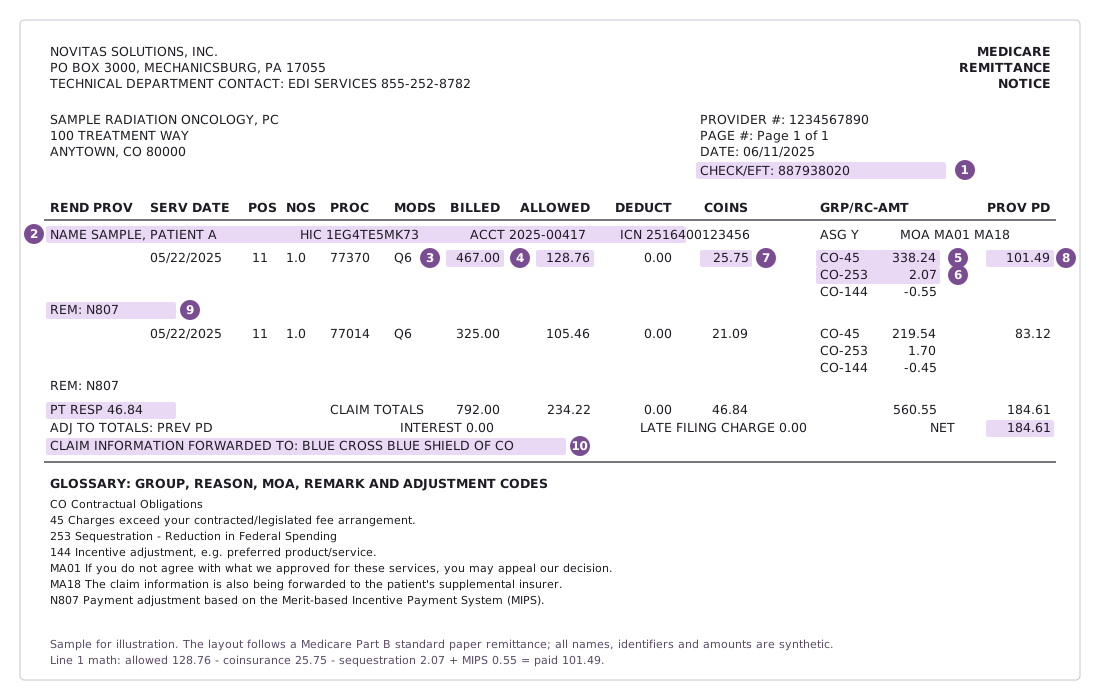
Billed, allowed, paid and written off
| Term | Who sets it | What it is |
|---|---|---|
| Billed (charge) | you | your fee schedule amount for the code; usually set well above any payer’s allowed amount so that no contract is underbilled |
| Allowed | the payer | the fee schedule or contracted amount for the code, place of service and modifier |
| Contractual adjustment (CO-45) | arithmetic | billed minus allowed; the write-off |
| Patient responsibility (PR-1, PR-2, PR-3) | the plan design | deductible, coinsurance and copay, calculated from the allowed amount |
| Payer-level reductions | law or contract | Medicare sequestration (CO-253), MIPS adjustments (CO-144), and similar items that change the payment but not the allowed amount |
| Paid | arithmetic | allowed minus patient responsibility minus payer-level reductions, plus any positive incentive |
Two consequences are worth saying plainly. Charging more than the allowed amount does not earn more; it only increases the CO-45. Charging less does cost you, because the payer allows the lower of your charge and its fee schedule. That is why practices keep charges above the highest contracted rate and review them when fee schedules change.
Participating, non-participating and out-of-network
For Medicare the allowed amount depends on the provider’s participation status.
| Status | Allowed amount | Who is paid | What the patient can be charged |
|---|---|---|---|
| Participating (accepts assignment on all claims) | the full Medicare fee schedule amount | the provider | deductible and coinsurance only |
| Non-participating, assigned claim | 95 percent of the participating amount | the provider | deductible and coinsurance on the reduced allowed amount |
| Non-participating, unassigned claim | 95 percent of the participating amount | the patient, who receives Medicare’s share and pays the provider | up to the limiting charge, 115 percent of the non-participating allowed amount |
| Opted out (private contract) | none; Medicare does not pay | the patient, under a private contract | whatever the contract says |
The 5 percent reduction for non-participants is in the Medicare Claims Processing Manual, Chapter 12, section 20.4.1, and Noridian’s enrollment page states the limiting charge as “115% of the non-participating fee schedule amount,” applying only to services billed on a non-assigned basis. Medicare.gov tells beneficiaries the same thing from their side: a non-participating provider’s charge generally cannot be more than 15 percent above the Medicare-approved amount.
For commercial payers the equivalent distinction is in network versus out of network. In network, the contract sets the allowed amount and you write off the difference. Out of network there is no contract, so there is no contractual obligation to write anything off; the plan still calculates an allowed amount by its own method (a percentage of Medicare, or a “usual and customary” figure), pays its share of that, and the rest is the patient’s unless federal or state balance-billing protections apply to the service.
Worked example
Illustrative figures for CPT 77427, weekly radiation treatment management, with a participating allowed amount of 200.00 and a charge of 420.00. The patient’s deductible is met.
| Participating | Non-par, assigned | Non-par, unassigned | |
|---|---|---|---|
| Billed | 420.00 | 420.00 | up to the limiting charge, 218.50 (190.00 x 1.15) |
| Allowed | 200.00 | 190.00 (200.00 x 0.95) | 190.00 |
| CO-45 write-off | 220.00 | 230.00 | none; the provider is not bound to the allowed amount |
| PR-2 coinsurance (20 percent of allowed) | 40.00 | 38.00 | 38.00 |
| Medicare share (80 percent of allowed) | 160.00 | 152.00 | 152.00 |
| CO-253 sequestration (2 percent of Medicare share) | 3.20 | 3.04 | 3.04 |
| Medicare pays | 156.80 to the provider | 148.96 to the provider | 148.96 to the patient |
| Provider collects from the patient | 40.00 | 38.00 | up to 218.50 |
| Patient’s net cost | 40.00 | 38.00 | 218.50 less 148.96 = 69.54 |
Check the first column: 220.00 + 40.00 + 3.20 + 156.80 = 420.00. The participating provider receives 196.80 in total; the non-participating provider on an unassigned claim can receive 218.50, but only by collecting all of it from the patient and carrying the collection risk. Most radiation oncology practices participate for exactly that reason.
What to do
- Load every payer’s fee schedule and compare the allowed amount on each remittance to it. A CO-45 larger than expected is the first sign of a wrong modifier, place of service, fee schedule year or multiple-procedure reduction. The variance report is where underpayments are found.
- Post CO-45 to contractual adjustments and nothing else. A CO code other than 45, 253 or 144 is a denial or reduction that needs a person, not a write-off.
- Never bill a patient for a CO-45 on an in-network or assigned claim. It is the discount you agreed to.
- For unassigned Medicare claims, bill the patient no more than the limiting charge and expect Medicare’s payment to go to the patient, not to you.
- Review your charge master when fee schedules change so that no charge falls below a contracted allowed amount.
- Denials to recognize: CO-45 with an unexpectedly large amount (fee schedule or modifier problem); CO-59 (multiple procedure payment reduction); CO-97 (bundled into another service). The first two are usually correct and reconcile; the third needs an NCCI check before any appeal.
Iridium Suite’s reporting shows billed, allowed and paid by CPT code and payer, which is where a fee schedule change or an underpayment first becomes visible.
Related terms
- GRP/RC-AMT: group codes, reason codes and amounts
- PR-1, PR-2 and PR-3: deductible, coinsurance and copay
- Sequestration on Medicare claims
- Facility versus non-facility rates
- CPT 77427: weekly radiation treatment management
- RO Model payment
Further reading: Medicare.gov: Does your provider accept Medicare as full payment?; Noridian: Nonparticipation; Medicare Claims Processing Manual, Chapter 12, section 20.4.1; CMS Physician Fee Schedule look-up tool.
Frequently asked
What is the allowed amount in medical billing?
The allowed amount is the maximum a payer will recognize for a service under its fee schedule or contract. Payment and the patient's deductible, coinsurance or copay are all calculated from it. The difference between your charge and the allowed amount is the contractual adjustment, written off when you are in network.
What is the difference between billed, allowed and paid?
Billed is your charge. Allowed is what the payer recognizes for the service. Paid is what the payer actually sends, which is the allowed amount minus the patient's share and any payer-level reductions such as Medicare sequestration. Billed minus allowed is the write-off.
What is CO-45?
CO-45 is the claim adjustment that carries the contractual write-off: group code CO (contractual obligation) and reason code 45, charge exceeds fee schedule or contracted amount. It is the normal, expected adjustment on every in-network claim and cannot be billed to the patient.
What is the Medicare limiting charge?
The limiting charge is the most a non-participating provider may charge a Medicare patient on an unassigned claim. It is 115 percent of the non-participating fee schedule amount, which is itself 95 percent of the participating amount, so it works out to about 9.25 percent above the participating allowed amount.