PR 1 in Medical Billing: PR-1 Deductible, PR-2 Coinsurance and PR-3 Copay Explained
PR 1 in medical billing (written PR-1 on most remittances) is the deductible: group code PR, patient responsibility, with reason code 1, deductible amount. The patient owes that amount; the practice does not write it off. PR-2 is coinsurance and PR-3 is the copay.
These three codes show the patient’s share of the bill. Posting them to the right balance is the main step in producing an accurate patient statement.
Where you see it
| Place | What you see |
|---|---|
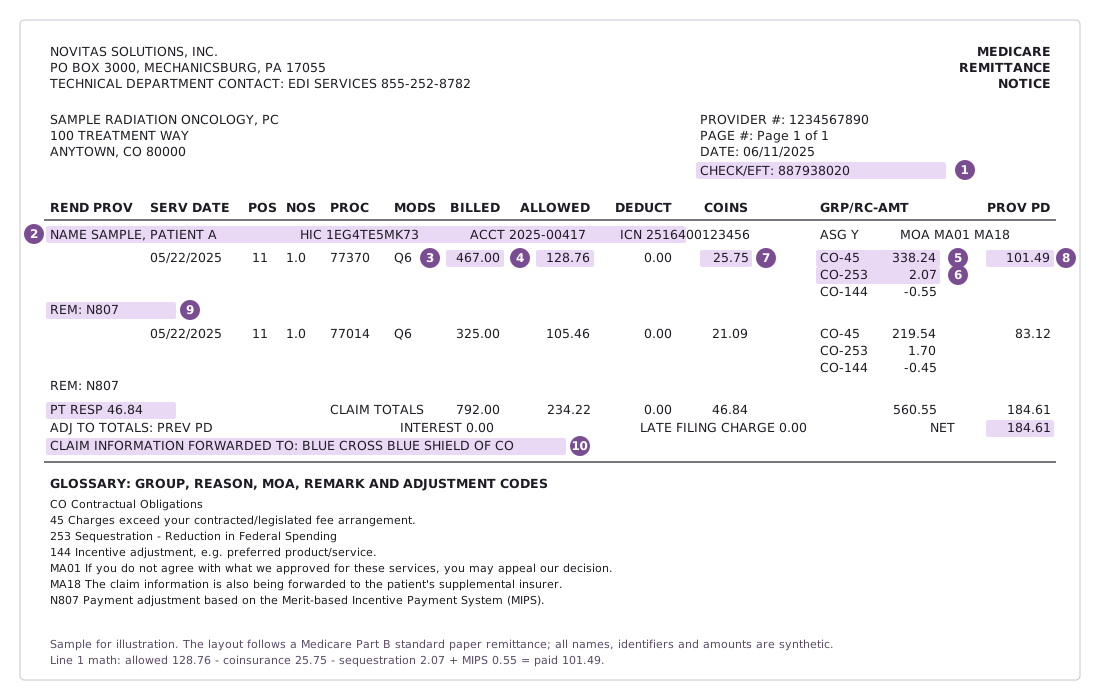
| Medicare Standard Paper Remittance | PR-1 has its own DEDUCT column and PR-2 its own COINS column, so the GRP/RC-AMT column usually shows only CO codes; the claim-level PT RESP total adds them up |
| ERA (835) | a CAS segment on the service line: CAS PR 1 (amount), CAS PR 2 (amount), CAS PR 3 (amount) |
| Commercial payer remittance or EOP | an “adjustment” or “reason” column reading PR-1, PR-2 or PR-3, or a “patient responsibility” column with footnotes |
| The patient’s EOB or MSN | “deductible,” “coinsurance,” “copay,” or “maximum you may be billed,” without the codes |
| Secondary claim (837) | the same CAS PR segments copied from the primary remittance so the secondary payer can see what the patient was left owing |
On the annotated remittance sample, callout 7 is the COINS column: 25.75 on the first line and 21.09 on the second, both PR-2, with DEDUCT 0.00 because this patient’s Part B deductible had already been met. PT RESP 46.84 is the two added together.
The three codes
| Code | Official text | What it is | Original Medicare Part B | Commercial and Medicare Advantage |
|---|---|---|---|---|
| PR-1 | Deductible Amount | what the patient pays each year before the plan pays anything | one annual Part B deductible, 283.00 for 2026 according to Medicare.gov; it is applied to the first claims of the year | plan deductibles vary widely and often reset on the plan year, not the calendar year |
| PR-2 | Coinsurance Amount | a percentage of the allowed amount | 20 percent of the allowed amount for most Part B services | varies by plan and by in-network versus out-of-network |
| PR-3 | Co-payment Amount | a flat dollar amount per visit or service | uncommon in Original Medicare Part B | the office-visit or specialist copay; frequent in Medicare Advantage |
Two things follow from the definitions. First, PR-1 and PR-2 are both calculated from the allowed amount, never from your charge, so a patient who owes “20 percent” owes 20 percent of what the payer allowed. Second, the deductible comes first: coinsurance is calculated on whatever allowed amount is left after the deductible is applied.
PR-96, PR-204 and the other PR codes
Deductible, coinsurance and copay are the routine PR codes. Two others appear often enough to learn:
| Code | Official text | When you see it |
|---|---|---|
| PR-96 | Non-covered charge(s) | a service the payer does not cover and holds the patient liable for. The code must come with a remark code explaining why. For Medicare it usually means an Advance Beneficiary Notice (ABN) was on file or the service is excluded by statute |
| PR-204 | This service/equipment/drug is not covered under the patient’s current benefit plan | the commercial equivalent: the plan does not cover it, so the patient owes it |
When PR is wrong, or right but not collectable
The group code is the payer’s statement of who is liable. It is usually correct, but there are cases where a PR should have been a CO, and cases where it is correctly PR yet you still may not bill the patient.
- Should have been CO. A Medicare denial for lack of medical necessity when no ABN was obtained is the provider’s liability, CO-50, not PR. If a payer sends PR for a service that your contract or the payer’s own rules make the provider’s responsibility, ask for reprocessing; billing the patient for it is a compliance problem, not a collection.
- Payer error on the deductible. PR-1 for a patient whose deductible was already met at another practice happens when claims are processed out of order. The payer will reprocess once the other claim posts. Hold the statement.
- Qualified Medicare Beneficiaries (QMB). Medicare’s remittance still shows PR-1 and PR-2, but federal law prohibits billing a QMB for Medicare deductibles, coinsurance or copays. The amount is billed to the state Medicaid program, usually by automatic crossover, and whatever Medicaid does not pay is written off.
- Patient has a secondary. PR amounts are correct, but they go to the Medigap, Medicaid or employer plan first. When Medicare’s remittance carries MA18 or MA07 the claim has already been forwarded; wait for the secondary’s remittance before any patient statement.
The general rule: a CO can never be billed to the patient, and a PR may be billed to the patient only after every other payer that could pay it has been billed.
Worked example
Illustrative figures for CPT 77427 (weekly radiation treatment management) in January, when the patient still has 50.00 of their Part B deductible to meet:
| Step | Amount | Posting |
|---|---|---|
| Billed | 420.00 | charge |
| Allowed | 180.00 | fee schedule |
| CO-45 contractual adjustment | 240.00 | contractual write-off |
| PR-1 deductible | 50.00 | patient (or secondary) balance |
| Allowed remaining after deductible | 130.00 | |
| PR-2 coinsurance (20 percent of 130.00) | 26.00 | patient (or secondary) balance |
| Medicare share (80 percent of 130.00) | 104.00 | |
| CO-253 sequestration (2 percent of 104.00) | 2.08 | contractual write-off |
| Paid | 101.92 | payment |
Check: 240.00 + 50.00 + 26.00 + 2.08 + 101.92 = 420.00. The patient’s share is 76.00. If the patient has a Medigap policy, the 76.00 goes to Medigap first; most Medigap plans pay the coinsurance, and whether they also pay the Part B deductible depends on the plan letter, so some of the 50.00 may come back to the patient.
What to do
- Post PR-1, PR-2 and PR-3 to the patient balance, or to the secondary if there is one. Never to the contractual adjustment account.
- Check eligibility before the first visit of the year. The Medicare eligibility response includes the Part B deductible remaining, so the front desk can tell the patient what to expect. Iridium Suite’s real-time eligibility check returns the remaining deductible along with coverage dates before the appointment.
- Hold statements when the remittance says the claim was forwarded. MA18 (supplemental insurer) and MA07 (Medicaid) mean a secondary remittance is coming.
- Confirm QMB status before billing any Medicare patient for cost sharing. It shows in the eligibility response and on the MAC portal.
- Question a PR that does not fit. PR-96 without an ABN on file, PR-1 after the deductible was met, PR for a service that needed an authorization you did not get: each is a phone call or a reprocessing request, not a patient statement.
Related terms
- GRP/RC-AMT: group codes, reason codes and amounts
- Allowed amount, billed amount and write-off
- Medicare crossover claims
- Sequestration on Medicare claims
- Coordination of benefits
- Understanding an EOB
Further reading: X12: Claim Adjustment Reason Codes; Medicare.gov: Medicare costs; CMS: Electronic Remittance Advice; CMS: Qualified Medicare Beneficiary program.
Frequently asked
What does PR-1 mean on a remittance?
PR-1 is the deductible. PR is the group code for patient responsibility and 1 is the claim adjustment reason code for deductible amount. The dollars next to it were applied to the patient's deductible, so the payer did not pay them and the patient (or a secondary payer) owes them.
What is the difference between PR-1, PR-2 and PR-3?
All three are patient responsibility. PR-1 is the deductible, the amount the patient pays before the plan starts paying. PR-2 is coinsurance, a percentage of the allowed amount, 20 percent for most Medicare Part B services. PR-3 is a copayment, a flat amount per visit or service, common in commercial and Medicare Advantage plans.
Can I bill the patient for every PR amount?
The group code says the payer considers the patient liable, which is usually correct, but not always collectable. You cannot bill a Qualified Medicare Beneficiary for Medicare cost sharing, you should bill the secondary payer first when the patient has one, and a PR that resulted from a payer error should be reprocessed, not billed.
What is PR-96 or PR-204?
PR-96 is a non-covered charge and PR-204 is a service not covered under the patient's benefit plan, both with the patient held responsible. For Medicare, PR-96 generally means the patient was told in advance (an ABN was signed) or the service is excluded by law; without that notice the same denial would come back as CO, and the provider writes it off.