Medicare Sequestration: The 2 Percent Payment Reduction, CO-253 and the Arithmetic
Medicare sequestration is the 2 percent reduction the federal government takes from Medicare’s share of each fee-for-service claim payment. It appears on the remittance as CO-253 and is calculated last, after the allowed amount, deductible and coinsurance have all been determined.
It is a small number on every line, and because it is small it is easy to post wrong or to forget when you reconcile what Medicare should have paid. Once you know where it falls in the calculation, it is easy to check.
Where you see it
| Place | What you see |
|---|---|
| Medicare Part B remittance (SPR) | CO-253 and an amount in the GRP/RC-AMT column on every paid service line |
| Medicare Part A remittance | the reduction at the claim level rather than the line level |
| ERA (835) | a CAS segment reading CO 253 (amount) on each service line (Part B) or at the claim level (Part A) |
| The patient’s MSN | nothing; the patient’s amounts are unaffected |
| Medicare Advantage remittances | depends on the plan’s contract with you; some plans pass the reduction through to contracted providers, others do not |
| Commercial remittances | never; sequestration is a federal budget measure and applies only to Medicare payments |
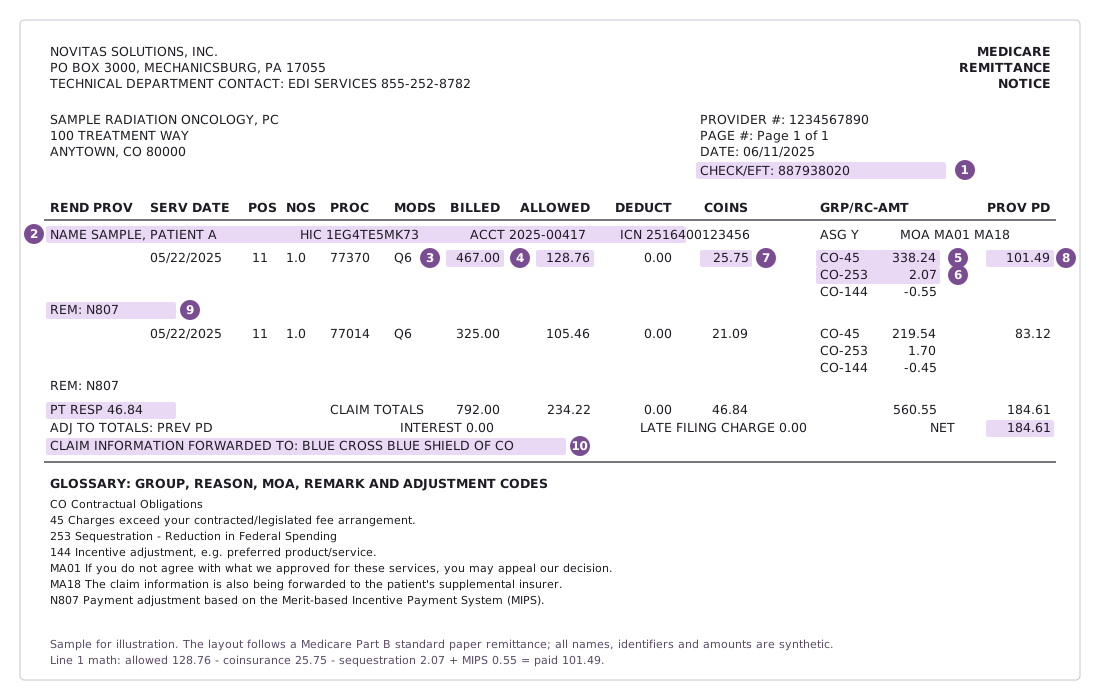
On the annotated remittance sample, callout 6 is CO-253 2.07 on the first line (77370) and 1.70 on the second (77014). It does not change the COINS column or the ALLOWED column.
Where it falls in the calculation
The order of operations on a Part B line is always the same:
- The payer determines the allowed amount for the code.
- Any remaining deductible (PR-1) is taken from the allowed amount.
- Coinsurance (PR-2), 20 percent of what is left, is assigned to the patient.
- The remaining 80 percent is Medicare’s share.
- Any MIPS adjustment (CO-144) is applied to Medicare’s share.
- Sequestration takes 2 percent of Medicare’s share. That is CO-253.
- What remains is paid.
Noridian describes it this way: the reduction “is taken from the calculated payment amount” after the approved amount is set and the deductible and coinsurance are applied, and “beneficiary payments for deductibles and coinsurance are not subject to the 2 percent payment reduction.” First Coast adds that fee schedules and pricers are unchanged; only the final payment is reduced.
Reading the sample’s first line that way: allowed 128.76, coinsurance 25.75, Medicare share 103.01, plus the MIPS incentive of 0.55 gives 103.56, and 2 percent of 103.56 is 2.07. Paid: 103.56 less 2.07 = 101.49, which matches PROV PD.
Worked example
Illustrative figures for CPT 77427 (weekly radiation treatment management) early in the year, when the patient still has 50.00 of Part B deductible to meet:
| Step | Amount |
|---|---|
| Allowed | 180.00 |
| PR-1 deductible | 50.00 |
| Allowed remaining | 130.00 |
| PR-2 coinsurance (20 percent of 130.00) | 26.00 |
| Medicare share (80 percent of 130.00) | 104.00 |
| CO-253 sequestration (2 percent of 104.00) | 2.08 |
| Paid | 101.92 |
| Patient owes (50.00 + 26.00) | 76.00 |
Without sequestration Medicare would have paid 104.00. With it, 101.92. The patient’s 76.00 is the same either way, and the 2.08 is written off. The next week, with the deductible met: allowed 180.00, coinsurance 36.00, Medicare share 144.00, sequestration 2.88, paid 141.12.
Noridian’s own example works the same way with round numbers: approved amount 100.00, deductible 50.00, coinsurance 10.00, Medicare share 40.00, reduction 0.80, paid 39.20.
Unassigned claims. When a non-participating provider does not accept assignment, Medicare pays the patient, and that payment to the patient is reduced by 2 percent. The provider may still collect up to the limiting charge from the patient; so the patient bears the reduction, not the provider. This is the only case where sequestration costs the patient money.
A short history
| Date | What happened |
|---|---|
| August 2011 | The Budget Control Act of 2011 required automatic across-the-board reductions if Congress did not agree on deficit targets |
| January 2013 | The American Taxpayer Relief Act of 2012 postponed the start by two months |
| March 1, 2013 | The sequestration order was issued |
| April 1, 2013 | The 2 percent reduction applied to Medicare fee-for-service claims with dates of service (or discharge) on or after this date |
| May 1, 2020 | The CARES Act suspended the reduction during the public health emergency |
| 2021 | The Consolidated Appropriations Act, 2021 extended the suspension to March 31, 2021, and a further act signed April 14, 2021 extended it to December 31, 2021 |
| December 2021 | The Protecting Medicare and American Farmers from Sequester Cuts Act extended the suspension to March 31, 2022, then phased the reduction back in |
| April 1 to June 30, 2022 | 1 percent reduction |
| July 1, 2022 onward | 2 percent reduction, which remains in effect at the time of writing |
Why the patient is never billed for it
Three reasons, any one of which is enough:
- The group code is CO, contractual obligation. CO amounts are the provider’s write-off by definition and may not be billed to the beneficiary.
- The law reduces Medicare’s payment, not the allowed amount. The patient’s deductible and coinsurance are computed on the full allowed amount, so the patient has already paid their full share.
- A Medigap or other secondary payer calculates its payment from Medicare’s allowed amount and the patient-responsibility amounts, so it does not pay the sequestration either. No one pays it; Medicare keeps that amount.
What to do
- Post CO-253 as a contractual adjustment, ideally under its own adjustment code, so the total lost to sequestration can be reported separately from fee schedule write-offs. For a radiation oncology practice the yearly total can be significant.
- Build the 2 percent into your expected-payment calculation. A remittance that pays exactly 98 percent of the expected Medicare share is correct; one that pays 100 percent is either a Medicare Advantage plan or a mistake.
- Do not appeal it, and do not bill it to the patient or the secondary.
- Check your Medicare Advantage contracts. Whether a plan may pass the reduction through to you is a contract question, and the answer differs by plan.
- Watch for it at the claim level on Part A remittances when posting hospital department claims, where it will not appear line by line.
Iridium Suite posts CO-253 from the ERA automatically as a contractual adjustment with its own reason code, so sequestration never reaches a patient statement and can be totaled on its own in reporting.
Related terms
- GRP/RC-AMT: group codes, reason codes and amounts
- Allowed amount, billed amount and write-off
- PR-1, PR-2 and PR-3: deductible, coinsurance and copay
- Remark codes: N807 and the MIPS adjustment
- EOB versus ERA
Further reading: Noridian: Sequestration; First Coast: Federal sequestration payment reductions; CGS: Medicare FFS claims, 2 percent payment adjustment (sequestration) schedule; X12: Claim Adjustment Reason Codes.
Frequently asked
What is Medicare sequestration?
Sequestration is an across-the-board reduction in federal spending required by the Budget Control Act of 2011. For Medicare fee-for-service it means a 2 percent reduction in the payment Medicare makes on each claim. It is applied after the allowed amount, deductible and coinsurance are determined, so only Medicare's share is reduced.
What is CO-253 on a remittance?
CO-253 is the claim adjustment that carries the sequestration reduction: group code CO (contractual obligation) and reason code 253, sequestration, reduction in federal payment. It appears on each service line of a Part B remittance and is written off; it cannot be billed to the patient or a secondary payer.
Can I bill the patient for the sequestration amount?
No. The patient's deductible and coinsurance are calculated on the full allowed amount and are not reduced by sequestration. The 2 percent comes only out of Medicare's share, and the CO group code marks it as the provider's write-off. Billing it to the patient would be billing a contractual obligation.
Is Medicare sequestration still in effect?
Yes. It began for dates of service on or after April 1, 2013, was suspended during the pandemic from May 1, 2020 through March 31, 2022, returned at 1 percent from April 1 through June 30, 2022, and has been back at 2 percent since July 1, 2022.