GRP/RC-AMT on a Medicare Remittance: Group Codes, Reason Codes and Amounts Explained
GRP/RC-AMT is the column on a Medicare remittance advice where every adjustment to a service line is shown as three things: the group code (who is responsible for the difference), the reason code (why the payer adjusted the charge), and the amount in dollars. A line reading CO-45 338.24 means the payer reduced the charge by 338.24 as a contractual obligation because the billed charge exceeded the fee schedule.
If you have ever looked at that column and wondered where the money went, you are not alone. It is the question new billers ask us most. Once you can read the three parts, the rest of the remittance is easy to follow.
Where you see it
GRP/RC-AMT appears on the Medicare Standard Paper Remittance (SPR) and in the printed version of the electronic remittance advice (ERA, the 835 transaction) that your practice management system produces. Commercial payers use the same group and reason codes on their EOBs, usually in a column labelled “Adjustment” or “Reason”. Every code is a national standard: the group codes and reason codes are published by X12 as the Claim Adjustment Reason Codes (CARC) and the remark codes as the Remittance Advice Remark Codes (RARC), so CO-45 means the same thing from Medicare, Aetna or Blue Cross. CMS explains the layout of the Medicare remittance itself in Remittance Advice Resources and FAQs from the Medicare Learning Network.
The sample below is a one-claim radiation oncology remittance from a Medicare contractor. The numbers in the image match the walk-through that follows.
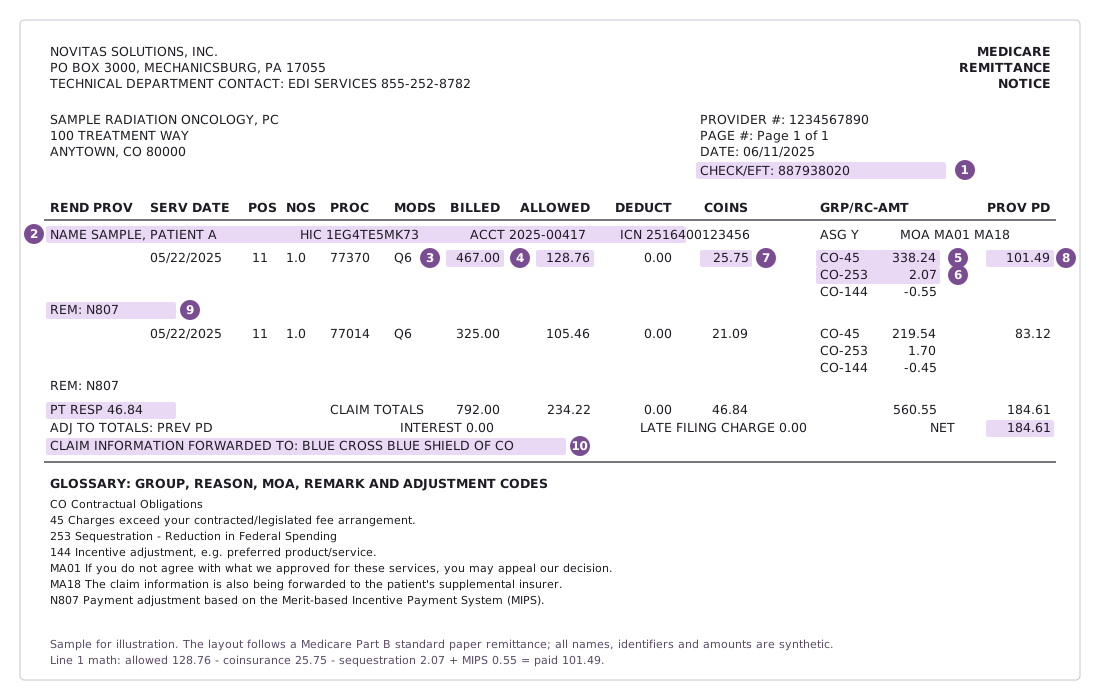
- CHECK/EFT is the payment this remittance explains. Post everything on the page against this one deposit.
- HIC, ACCT and ICN identify the patient (Medicare Beneficiary Identifier), your account number for the visit, and the payer’s internal control number for the claim. You need the ICN for any appeal or reopening.
- BILLED is what you charged.
- ALLOWED is the fee schedule amount for the code, place of service and modifier.
- GRP/RC-AMT, the column this article is about. Here:
CO-45 338.24. - CO-253, the sequestration reduction.
- COINS is the 20 percent coinsurance the patient owes on the allowed amount. The claim-level PT RESP adds the coinsurance and deductible for every line.
- PROV PD is what Medicare paid for the line; NET is the claim total after interest and late-filing charges.
- MOA and REM codes (MA01, MA18, N807) are remark codes that explain rather than adjust: appeal rights, crossover forwarding, and the MIPS adjustment.
- CLAIM INFORMATION FORWARDED TO means Medicare sent the claim to the patient’s supplemental insurer automatically. Do not bill the secondary yourself; wait for the crossover.
The three parts of every adjustment
Group code: who is responsible
| Group | Meaning | Can you bill the patient? |
|---|---|---|
| CO | Contractual Obligation: the provider’s write-off under its contract or, for Medicare, the law | No |
| PR | Patient Responsibility: deductible, coinsurance, copay, non-covered services the patient agreed to | Yes |
| OA | Other Adjustment: neither party is liable, for example a duplicate or a coordination-of-benefits situation | Usually no |
| PI | Payer Initiated Reduction: the payer reduced payment for a reason that is not contractual and not the patient’s, often pending review | No, pending appeal |
The group code is the one that matters for your accounts receivable. CO goes to the contractual adjustment account. PR moves the balance to the patient. OA and PI need follow-up.
Reason code: why
The reason code is a number from the national Claim Adjustment Reason Code (CARC) list. The ones you will see most on a radiation oncology remittance:
| Code | Meaning | What to do |
|---|---|---|
| 45 | Charge exceeds the fee schedule or contracted amount | Nothing; this is the normal fee-schedule write-off |
| 253 | Sequestration, the 2 percent federal reduction, applied after deductible and coinsurance (Noridian’s explanation) | Nothing; it cannot be billed to anyone |
| 144 | Incentive adjustment (MIPS) | Nothing; negative means you were paid more |
| 1 | Deductible amount (always with PR) | Bill the patient |
| 2 | Coinsurance amount (always with PR) | Bill the patient, or the secondary if there is one |
| 3 | Copayment amount (always with PR) | Bill the patient |
| 4 | Procedure code inconsistent with the modifier | Check the modifier and resubmit a corrected claim |
| 16 | Claim lacks information needed for adjudication | Read the remark code that comes with it, fix, resubmit |
| 18 | Duplicate claim | Find the original; do not resubmit |
| 29 | Time limit for filing has expired | Appeal only with proof of timely filing |
| 50 | Not medically necessary | Appeal with documentation, or write off |
| 96 | Non-covered charge | Check the remark code; may be billable to the patient with an ABN |
| 97 | Payment included in another service already adjudicated | Bundled; check NCCI edits before appealing |
| 119 | Benefit maximum reached | Bill the patient or the secondary |
| 197 | Precertification or authorization absent | Obtain retro-authorization if the payer allows, otherwise appeal |
Amount
The dollar figure for that adjustment. The amounts for one service line, together with the deductible and coinsurance, always reconcile billed to paid.
Worked example: line 1 of the sample
Service: CPT 77370, special medical radiation physics consultation, modifier Q6 (locum tenens physician), place of service 11, date of service 05/22/2025.
| Step | Amount | Where it comes from |
|---|---|---|
| Billed | 467.00 | your charge |
| less CO-45 contractual adjustment | 338.24 | billed minus allowed |
| Allowed | 128.76 | fee schedule |
| less coinsurance (PR-2, shown in COINS) | 25.75 | 20 percent of 128.76 |
| less CO-253 sequestration | 2.07 | 2 percent of 103.56 (the 80 percent Medicare share of 103.01 plus the 0.55 MIPS incentive) |
| plus CO-144 MIPS adjustment | 0.55 | positive incentive, shown as -0.55 |
| Provider paid | 101.49 | matches PROV PD |
So of 467.00 billed, 338.24 is written off under CO, 25.75 is billed to the patient (or sent to the crossover payer), 2.07 is lost to sequestration, and 101.49 arrived in the EFT. Every line on every remittance reconciles this way. If your posting does not balance, compare it with the remittance to find the number you missed. The second line, 77014, follows the same pattern: 325.00 billed, 219.54 CO-45, 105.46 allowed, 21.09 coinsurance, 1.70 sequestration, 0.45 MIPS, 83.12 paid. Claim totals: 792.00 billed, 234.22 allowed, 46.84 patient responsibility, 184.61 paid.
What to do with each group when you post
- CO amounts post to contractual adjustments. If a CO reason code is anything other than 45, 253 or 144, it means something went wrong with the claim (modifier, bundling, medical necessity), and the line belongs on a work list, not in the write-off account.
- PR amounts move to patient or secondary balance. When MA18 says the claim was forwarded, hold the patient statement until the crossover payer responds.
- OA and PI amounts are never routine. Each one needs a person to decide whether to correct, appeal or write off.
A habit worth building: before you post any remittance, scan the GRP/RC-AMT column for anything that is not CO-45, CO-253, CO-144 or a PR code. Those few lines are the ones the practice may not get paid for, and they are easy to miss in a page of routine adjustments.
In Iridium Suite the ERA posts automatically and each adjustment posts to the right account by group code; lines with non-routine reason codes are routed to the denial work list instead of being written off, which is the step most practices miss when posting by hand. (One sentence, linked to the Accounts Receivable feature page.)
Related terms
Frequently asked
What does GRP/RC-AMT mean on an EOB or remittance?
It is the column where the payer lists each adjustment as a group code (who is responsible), a reason code (why), and the dollar amount. CO-45 338.24 means a contractual obligation of 338.24 because the charge exceeded the fee schedule.
What is the difference between CO and PR?
CO (contractual obligation) is money the provider writes off under its agreement with the payer; the patient cannot be billed for it. PR (patient responsibility) is money the patient owes, such as a deductible or coinsurance.
What is CO-253 on a Medicare remittance?
CO-253 is the 2 percent Medicare sequestration reduction. It is taken from the payment after the deductible and coinsurance are calculated, and it cannot be billed to the patient.
Why is CO-144 a negative number?
CO-144 is an incentive adjustment. A negative amount in the adjustment column means the payer added money, in this case a positive MIPS payment adjustment, so the provider was paid more than the plain fee schedule amount.