EDI in Medical Billing: The 837, the 835 and the Other HIPAA Transactions Explained
EDI in medical billing means the exchange of claims, remittances, eligibility checks and claim status between a practice, a clearinghouse and a payer in the standard X12 formats HIPAA requires. Each document type has a number. The claim is the 837; the remittance that comes back is the 835.
When the original version of this article was written, the point was that electronic claims are better than paper. Electronic claims are now standard. What a biller needs now is to know which transaction does what, and how to read the ones that come back.
Where you see it
| Place | What goes there |
|---|---|
| The claim batch | The 837P file your billing system builds; a hospital’s billing system builds an 837I |
| Clearinghouse portal or reports | The 999 and 277CA acknowledgments, usually translated into a readable accept/reject report |
| Remittance posting | The 835 file, which your system turns into a readable remittance like our annotated Medicare sample |
| Eligibility screen | A 270 request goes out when you check coverage; the 271 response supplies what the screen shows |
| Claim status screen | A 276 request; the 277 response says where the claim is |
| Prior authorization | The 278, where the payer supports it electronically |
| Medicare enrollment | The Administrative Simplification Compliance Act requires Medicare claims to be sent electronically, with limited exceptions |
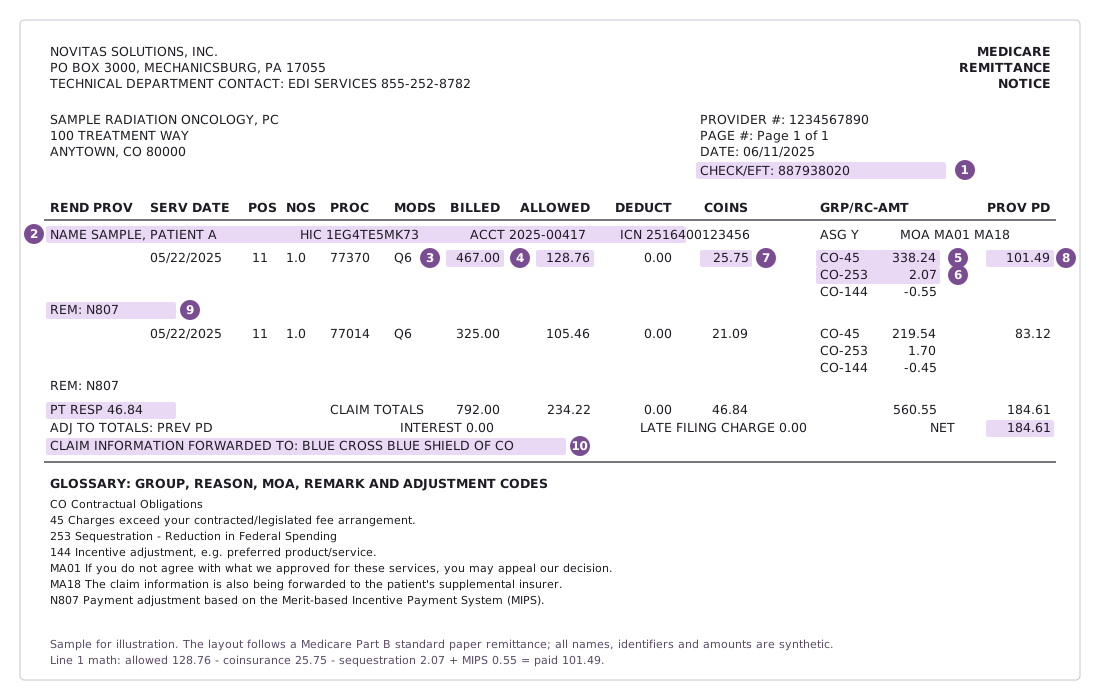
The HIPAA transaction set for billers
HHS adopted X12 version 5010 for all of these with a compliance date of January 1, 2012. The versions have not changed since.
| Transaction | Name | Direction | What it does |
|---|---|---|---|
| 837P | Health care claim, professional | practice to payer | the electronic CMS-1500 |
| 837I | Health care claim, institutional | hospital to payer | the electronic UB-04; the hospital’s technical charges travel here |
| 835 | Health care claim payment and remittance advice | payer to practice | allowed, adjusted and paid amounts per line, with CARC and RARC codes; pairs with the EFT through the TRN reassociation number |
| 270 / 271 | Eligibility inquiry and response | practice to payer and back | coverage, plan, copay, deductible remaining |
| 276 / 277 | Claim status request and response | practice to payer and back | where a claim is in adjudication, without a phone call |
| 278 | Services review (prior authorization and referral) | practice to payer and back | authorization requests and responses |
| TA1 | Interchange acknowledgment | receiver to sender | the outer envelope was or was not readable |
| 999 | Implementation acknowledgment | receiver to sender | the file passed or failed X12 syntax: accepted (A), accepted with errors (E), rejected (R) |
| 277CA | Claim acknowledgment | payer to practice | each claim accepted (with a claim number) or rejected, before adjudication |
The 834 (enrollment) and 820 (premium payment) are in the HIPAA set too but belong to employers and plans, not to billers. The TA1, 999 and 277CA are not HIPAA-mandated; Medicare adopted them for fee-for-service and most commercial payers followed.
Clearinghouses
A clearinghouse sits between the practice and its payers. It receives one 837 batch, checks it against its own edits and each payer’s companion guide, splits it, converts formats where a payer needs something different, delivers each claim to the right payer, and collects the acknowledgments and 835s coming back. It also translates the raw X12 into reports a person can read. A practice can connect directly to Medicare through its MAC instead; most do not, because one connection is easier to keep working than forty.
The clearinghouse’s own edit report is not the payer’s answer. A claim can pass the clearinghouse and still reject at the payer.
The flow of one claim
- Charge entry and scrub. The service line is checked against coding edits and payer rules before it ever becomes a file.
- 837P built and sent. The batch goes to the clearinghouse. A TA1 or 999 confirms the file was readable.
- Clearinghouse edits. Claims that fail come back on the clearinghouse’s report; the rest go to the payer.
- Payer front end. The payer returns a 999 for the file. If the 999 is accepted, a 277CA follows for each claim; a rejected 999 means no 277CA at all, and the whole batch has to be fixed and resent. One MAC puts the turnaround at one to 48 hours.
- Adjudication. Only claims accepted on the 277CA enter the payer’s system and receive a claim number (ICN). A 276 requests their status; the 277 returns it.
- 835 and payment. The payer issues the 835 and the EFT. The TRN segment on both lets the system match them.
- Posting. Contractual adjustments write off, patient responsibility moves to the patient balance, secondary balances forward, and denials go to a work list by group and reason code.
Rejections vs denials
| Rejection | Denial | |
|---|---|---|
| Where it appears | 999, 277CA, or the clearinghouse report | 835 remittance |
| Did the payer adjudicate it? | no; it never entered the payment system | yes |
| Claim number assigned? | no (a 277CA rejection has no ICN) | yes |
| Codes | 999 syntax codes; 277CA status category, status and entity codes | CARC and RARC |
| Fix | correct and resubmit as a new claim | corrected claim (frequency code 7) or appeal, depending on the reason |
| Timely filing | the filing limit still applies; a rejected claim was never received for filing purposes | the original receipt date counts |
One point X12 itself has clarified: a 999 with an A does not mean the payer accepted your claims. It means the file had no format errors “from a syntactic viewpoint.” Business acceptance, and the receipt date that matters for timely filing, come from the 277CA.
Worked example: one batch, twelve claims
Sample Radiation Oncology sends an 837P with twelve claims on Monday evening.
- Tuesday morning the clearinghouse shows a 999 with IK5*A: the file is syntactically clean.
- The payer’s 277CA lists eleven claims accepted, each with an ICN, and one rejected with STC codes A7, 562 and 85: rejected for invalid information, the entity’s NPI, billing provider. Someone keyed a new location’s billing NPI wrong. That claim has no ICN and no timely filing receipt; it is corrected and sent again on Tuesday.
- Two weeks later the 835 arrives for the eleven. One line for 77427 reads: billed 240.00, allowed 180.00, CO-45 60.00, PR-1 50.00, paid 130.00 (illustrative figures). The 60.00 writes off, the 50.00 goes to the patient’s deductible balance, and 130.00 posts against the EFT with the matching TRN.
- A twelfth-claim 835 follows a week after that.
Nothing in that batch needed a phone call.
What to do
- Work the 999 and 277CA every day. A rejected claim nobody notices is a claim that ages past timely filing without ever being received.
- Treat a rejection as a resubmission, never an appeal. There is nothing to appeal; the payer has no record of it.
- Reconcile every 835 to an EFT by TRN. An 835 with no deposit, or a deposit with no 835, is the first sign of a problem with the payer’s enrollment records.
- Run 270/271 before the visit and 276/277 before you call. Both return results in seconds and both leave a record.
- Keep the payer companion guides. They say what a payer wants beyond the base standard, and most front-end rejections trace back to one line in them.
- Iridium Suite sends 837P claims and imports 835 remittances through Shavara’s Connectivity Clearinghouse, which also carries the interface traffic between the billing system and the practice’s other systems.
Related terms
- EOB vs ERA
- Claim adjustment group and reason codes
- Remark codes
- HIC, MBI and ICN
- Timely filing
- CMS-1500 box by box
Further reading: CMS: Adopted Standards and Operating Rules (HIPAA transactions); X12 transaction sets; X12 RFI 2099: what a 999 does and does not confirm; CMS: Electronic Billing and EDI Transactions.
Frequently asked
What is EDI in medical billing?
EDI, electronic data interchange, is the exchange of billing documents between a practice, a clearinghouse and a payer in the standard X12 formats HIPAA requires. A claim is an 837, a remittance is an 835, an eligibility check is a 270 with a 271 response, and a claim status check is a 276 with a 277 response.
What is the difference between an 837 and an 835?
The 837 is the claim the practice sends to the payer: patient, provider, diagnoses, service lines and charges. The 835 is the remittance the payer sends back after adjudication: what was allowed, adjusted, paid and why, line by line, with CARC and RARC codes. The 835 is the electronic form of the EOB.
What is the difference between a claim rejection and a denial?
A rejection happens before adjudication: the clearinghouse or the payer's front end found a problem with the file or the claim and never entered it into the payment system. It comes back on a 999 or 277CA and is fixed and resubmitted as a new claim. A denial is an adjudicated decision on the 835 with a claim number, a reason code, and appeal rights.
What is a 277CA?
The 277CA is the claim acknowledgment Medicare and many payers return after a claim file passes syntax checks. It reports each claim as accepted or rejected, and for accepted claims it carries the payer's claim number. A rejected claim on the 277CA was never adjudicated and will not appear on an 835.