Remark Codes in Medical Billing: RARC vs CARC, and What MA01, MA18, N290 and N807 Mean
Remark codes, formally Remittance Advice Remark Codes (RARCs), are the alphanumeric codes beginning with M, MA or N on a remittance that add explanation to an adjustment or carry information a reason code alone cannot. They add explanation only and do not change any amounts.
The reason code states what the payer did with the charge. The remark code adds the detail, and often says what to fix. Learning the dozen most common remark codes is one of the fastest ways for a new biller to become productive.
Where you see it
| Place | What you see |
|---|---|
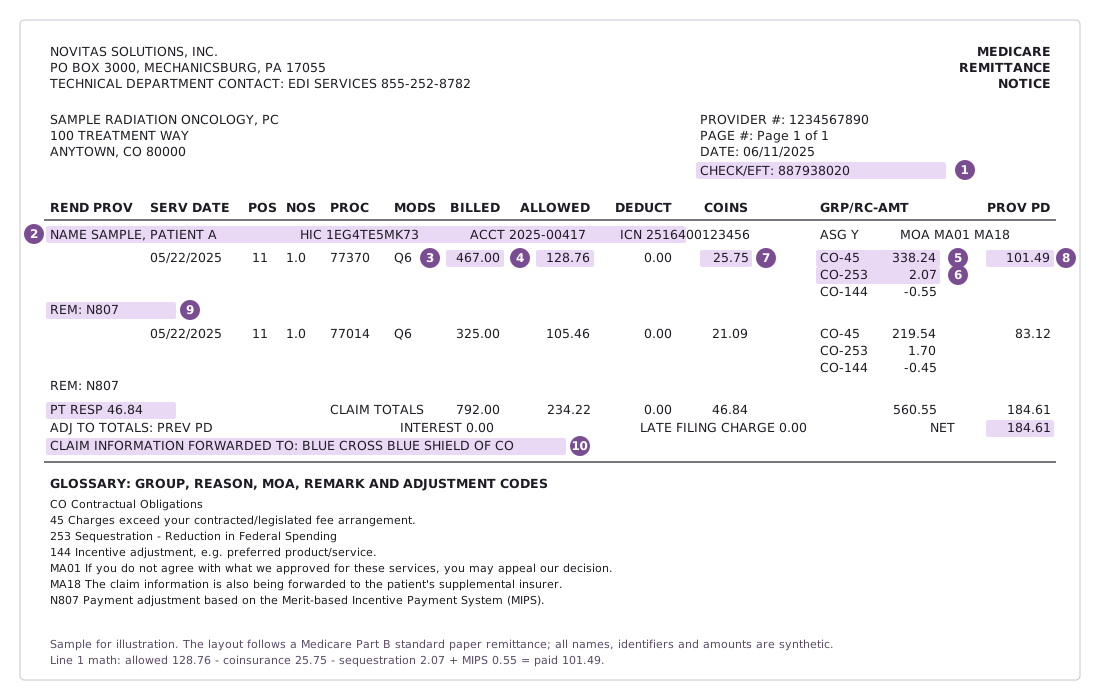
| Medicare Standard Paper Remittance, claim level | the MOA field (Medicare outpatient adjudication) listing up to five remark codes for the whole claim, such as MOA MA01 MA18 |
| Medicare Standard Paper Remittance, line level | REM: followed by the codes for that service line, such as REM: N807 |
| ERA (835) | the MOA segment at the claim level (MIA for inpatient), and LQ segments at the service-line level |
| Commercial payer remittance or EOP | “remarks,” “message codes” or footnote letters keyed to text at the bottom of the page; many payers use the national RARCs, some use their own codes alongside them |
On the annotated remittance sample, callout 9 points to both kinds: MOA MA01 MA18 at the claim level, and REM: N807 on each line beside the CO-144 MIPS adjustment. None of the three changes a dollar figure.
CARC versus RARC
| Claim Adjustment Reason Code (CARC) | Remittance Advice Remark Code (RARC) | |
|---|---|---|
| Format | number, 1 to 3 digits (45, 253, 16) | letters and digits (MA01, M80, N290) |
| Reported with | a group code (CO, PR, OA, PI) and a dollar amount | nothing; it is text only |
| Purpose | why the payer adjusted the charge, and who is liable | further explanation of an adjustment, or general information |
| Maintained by | the X12 Claim Adjustment Status Code Committee; published at x12.org | CMS, for use by any health plan; published at x12.org |
| Required | every adjustment must have one | when a CARC is not specific enough, and always for a few CARCs such as 16 and 96 |
Two kinds of RARC exist. Supplemental remarks explain a specific adjustment and are reported with a CARC. Informational remarks begin with the word “Alert:” and may appear without any adjustment at all; the Medicare Claims Processing Manual, Chapter 22, section 60.3, uses MA01 as its example. The RARC list is updated three times a year, at the same time as the CARC list.
The remark codes you will see most
| Code | Meaning (paraphrased from the X12 list) | What to do |
|---|---|---|
| MA01 | Alert: you may appeal if you disagree with what was approved, within the stated time limit | nothing; it is on nearly every Medicare remittance |
| MA18 | Alert: the claim information is also being forwarded to the patient’s supplemental insurer | do not bill the secondary; wait for the crossover payment |
| MA07 | Alert: the claim information has also been forwarded to Medicaid for review | same; and do not bill the patient if they are a QMB |
| MA19 | information was not sent to the Medigap insurer because the insurer information submitted was incorrect or invalid | bill the secondary yourself, and fix the Medigap data on file |
| MA130 | the claim contains incomplete or invalid information and no appeal rights are afforded | the claim was unprocessable; correct and resubmit, do not appeal |
| N290 | missing, incomplete or invalid rendering provider primary identifier | fix the rendering NPI (box 24J) and resubmit |
| N257 | missing, incomplete or invalid billing provider primary identifier | fix the billing NPI (box 33a) and resubmit |
| M15 | separately billed services have been bundled as components of the same procedure | check NCCI edits; appeal only if the modifier was valid and omitted |
| M80 | not covered when performed during the same session or date as a previously processed service | a frequency or same-day edit; review before resubmitting |
| N130 | consult plan benefit documents for restrictions on this service | a commercial benefit limit; the patient may be liable |
| N522 | duplicate of a claim processed, or to be processed, as a crossover claim | you billed the secondary too soon; the crossover will pay |
| N807 | payment adjustment based on the Merit-based Incentive Payment System (MIPS) | nothing; it explains CO-144 |
Reading a CARC and RARC pair
Always read the CARC and the RARC together. CO-16 (claim lacks information) alone does not say what to fix; CO-16 with N290 means the rendering NPI needs correcting, which is a quick fix. The common pairs:
| Pair | What it means | Action |
|---|---|---|
| CO-16 + N290 | rendering NPI missing or wrong | correct 24J, resubmit |
| CO-16 + MA130 | unprocessable claim, no appeal rights | find the error, resubmit as a new claim |
| CO-97 + M15 | bundled into another service | NCCI check; corrected claim with modifier if one applies, otherwise write off |
| CO-18 + N522 | duplicate of a crossover | wait for the secondary remittance |
| CO-144 + N807 | MIPS adjustment | post; a negative amount means a higher payment |
Worked example
A corrected claim shows how a remark code changes the follow-up work but not the amounts. Illustrative figures for CPT 77301 (IMRT treatment planning), billed at 2,400.00 with a wrong rendering NPI:
| First remittance | Amount |
|---|---|
| Billed | 2,400.00 |
| CO-16 (claim lacks information), with remark N290 | 2,400.00 |
| Paid | 0.00 |
After the NPI is corrected and the claim resubmitted:
| Second remittance | Amount |
|---|---|
| Billed | 2,400.00 |
| Allowed | 1,900.00 |
| CO-45 contractual adjustment | 500.00 |
| PR-2 coinsurance (20 percent of 1,900.00) | 380.00 |
| CO-253 sequestration (2 percent of 1,520.00) | 30.40 |
| Paid | 1,489.60 |
Check: 500.00 + 380.00 + 30.40 + 1,489.60 = 2,400.00. Had the first remittance been posted as a write-off because “CO means contractual,” the practice would have lost 1,489.60 in payment and 380.00 in patient coinsurance on one line. The remark code showed the biller that the claim needed a correction, not a write-off.
What to do
- Read the remark text, not just the code. Every Medicare remittance prints a glossary at the end; the 835 carries the codes and your system should display the text beside them.
- Sort remarks into three groups: informational alerts (MA01, MA18, MA07, N807) that need no action beyond holding statements where a crossover is coming; correction remarks (N290, N257, MA130) that mean resubmit; and policy remarks (M15, M80, N130) that need a decision between corrected claim, appeal and write-off.
- Never appeal an MA130. It means the claim was never processed, and appeals of unprocessable claims are dismissed. Resubmit.
- Capture the remark code on the denial record. Trending N290 or N257 across a month points to a provider-setup problem, not a one-off typo.
Iridium Suite displays the CARC and RARC text beside each denied line on the accounts receivable work list, so the biller does not have to look N290 up before acting on it.
Related terms
- GRP/RC-AMT: group codes, reason codes and amounts
- NPI numbers: rendering versus billing
- Medicare crossover claims
- PR-1, PR-2 and PR-3: deductible, coinsurance and copay
- EOB versus ERA
Further reading: X12: Remittance Advice Remark Codes; X12: Claim Adjustment Reason Codes; Medicare Claims Processing Manual, Chapter 22, section 60.3; MLN booklet: Remittance Advice Resources and FAQs.
Frequently asked
What is the difference between a remark code and a reason code?
A reason code (CARC) is numeric, always has a group code and a dollar amount, and says why the payer adjusted the charge. A remark code (RARC) is alphanumeric, carries no dollars, and adds detail or information. CO-16 means the claim lacked information; the remark code N290 identifies which information: the rendering provider NPI.
What does MA01 mean?
MA01 is an informational remark: if you do not agree with what was approved, you may appeal, and the appeal must be filed within the stated time limit. It appears on almost every Medicare remittance and does not indicate a problem.
What does MA18 mean on a Medicare remittance?
MA18 means the claim information is also being forwarded to the patient's supplemental insurer. The crossover has happened automatically, so do not bill the secondary payer yourself; wait for its remittance.
What is N807?
N807 is the remark that explains a CO-144 adjustment: the payment was adjusted under the Merit-based Incentive Payment System (MIPS). A negative CO-144 amount means the practice earned a positive adjustment and was paid more than the fee schedule amount.