ERA in Medical Billing: EOB vs ERA vs Remittance Advice, and Who Receives Which
An ERA in medical billing is the electronic remittance advice: the X12 835 file a payer sends a provider after it adjudicates a claim, listing what was billed, allowed, adjusted and paid, line by line. The EOB is the same decision written for the patient.
If the abbreviations EOB, ERA, EOMB, EOP and RA have ever made you hesitate before answering a patient’s question, you are not alone. There are really only two documents here, one for the patient and one for the provider, and everything else is a regional or historical name for one of them.
Where you see it
| Document | Who receives it | Format | What it is for |
|---|---|---|---|
| ERA (electronic remittance advice) | the provider, through a clearinghouse or practice management system | X12 835 file | automatic posting of payments and adjustments; the official record of the claim decision |
| SPR (standard paper remittance) | the provider, from a Medicare contractor, when not enrolled for ERA | paper | the same content as the ERA, posted by hand |
| RA (remittance advice) | the provider | either | the general term CMS uses for both ERA and SPR |
| EOP (explanation of payment) | the provider | paper or portal PDF | some commercial payers’ name for their paper remittance |
| EOB (explanation of benefits) | the patient | mail or member portal | explains the decision to the patient; not a bill |
| MSN (Medicare Summary Notice) | the Original Medicare beneficiary | mailed periodically, or online through a Medicare.gov account | the patient’s explanation, with appeal rights; not a bill |
| EOMB (explanation of Medicare benefits) | historical | the old name for the MSN, still heard in practice |
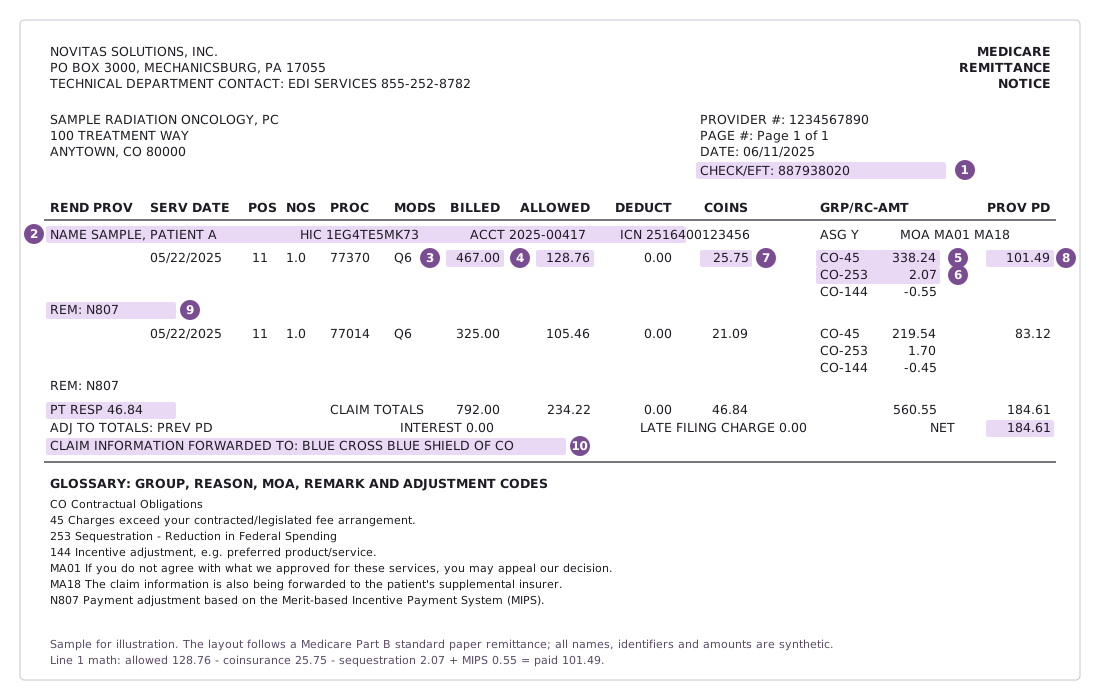
The annotated remittance sample on this site is a Medicare SPR: a paper rendering of exactly what the 835 carries for the same claim, including the MOA remark codes (MA01, MA18), the CO-45, CO-253 and CO-144 adjustments, and the “claim information forwarded to” line. The patient whose claim it is would receive an MSN with the same billed, approved and “maximum you may be billed” figures, and nothing about CO codes at all.
One decision, three documents
When a payer adjudicates a claim it produces one result, and that result is recorded in three places. The payer keeps its own record. The provider receives a remittance advice, electronic or paper, so it can post the payment and know what the patient owes. The patient receives an explanation of benefits (or, for Original Medicare, an MSN) so they can check the provider’s bill against it. Because all three come from one adjudication, the numbers always agree, and when a patient says “my EOB shows something different from your bill,” one of the two documents has been misread or the claim has since been reprocessed.
CMS is explicit that the beneficiary notice and the provider notice are different documents for different audiences: “While providers get an ERA or SPR, Medicare beneficiaries get a Medicare Summary Notice (MSN),” in the words of the Remittance Advice Resources and FAQs booklet. In everyday speech plenty of billers call the provider’s paper remittance an EOB too. That is harmless inside the office, but it is worth being precise with patients, who only ever see the EOB.
Paper versus 835
The SPR and the 835 carry the same codes, which is why the sample remittance can stand in for either. The difference is what a computer can do with them.
| SPR, EOP or other paper remittance | ERA (835) | |
|---|---|---|
| Payment | check number or EFT number printed at the top | BPR segment with the payment amount and TRN segment with the trace number that matches the bank deposit |
| Claim | one block per patient with billed, allowed, deductible, coinsurance, adjustments, paid | CLP segment per claim with billed, paid, patient responsibility and the payer’s claim control number (ICN) |
| Service line | one row per CPT code | SVC segment per line, with CAS segments for each adjustment (group, reason, amount) |
| Remark codes | MOA field at the claim level, REM after each line | MOA segment at the claim level, LQ segment at the line level |
| Provider-level items (interest, recoupments, offsets) | “adjustments to totals” at the bottom | PLB segment |
| Posting | typed by a person | imported and posted by the practice management system |
Medicare treats the paper as the fallback. Under the Medicare Claims Processing Manual, Chapter 22, section 50, contractors must be able to produce an SPR for providers who cannot or choose not to receive an ERA, but they stop mailing the SPR once a professional provider has been receiving ERAs for more than 45 days (31 days for institutional providers). CMS also notes that ERAs “generally contain more detailed information” than SPRs and can be posted automatically to billing systems.
Worked example
Illustrative figures for one weekly radiation treatment management service, CPT 77427, billed to Medicare by a participating freestanding center:
| Step | Amount |
|---|---|
| Billed | 420.00 |
| Allowed (fee schedule) | 180.00 |
| CO-45 contractual adjustment (420.00 less 180.00) | 240.00 |
| PR-2 coinsurance (20 percent of 180.00) | 36.00 |
| Medicare share before sequestration (180.00 less 36.00) | 144.00 |
| CO-253 sequestration (2 percent of 144.00) | 2.88 |
| Paid | 141.12 |
The same result appears three ways:
- On the patient’s MSN: the amount the provider charged (420.00), the Medicare-approved amount (180.00), and the maximum the patient may be billed (36.00). No group codes, no sequestration line.
- On the provider’s SPR: BILLED 420.00, ALLOWED 180.00, COINS 36.00, GRP/RC-AMT CO-45 240.00 and CO-253 2.88, PROV PD 141.12.
- In the 835: an SVC line for 77427 with 420.00 billed and 141.12 paid, followed by three CAS segments: CO 45 240.00, PR 2 36.00 and CO 253 2.88. The practice management system reads those segments and posts the contractual write-off, the patient balance and the payment without anyone typing a number.
In every version 240.00 + 36.00 + 2.88 + 141.12 = 420.00. If your posting does not balance to the billed amount, something was skipped.
What to do
- Enroll for ERA and EFT with every payer that offers them. Medicare contractors and most commercial payers have an enrollment form; clearinghouses can submit many of them for you. Paper remittances should be the exception, not the workflow.
- Post from the provider’s remittance, never from the patient’s EOB. The EOB is the patient’s copy and lacks the detail you need. The one exception is a non-assigned claim where the payer paid the patient and the EOB is the only document you will see.
- Match the TRN trace number to the deposit before posting. If an 835 does not tie to a bank deposit, ask the payer before you post it.
- Posting by hand from an SPR or EOP? Enter the group and reason codes, not just the dollars; a write-off posted without its CO-45 cannot be audited later.
Iridium Suite imports the 835 and posts each line’s payment and adjustments by group and reason code, so the paper remittance becomes a backup rather than the daily routine; see Accounts Receivable.
Related terms
- Understanding an EOB
- GRP/RC-AMT: group codes, reason codes and amounts
- Remark codes (RARC)
- PR-1, PR-2 and PR-3: deductible, coinsurance and copay
- Medicare crossover claims
- HIC, MBI and ICN
Further reading: CMS: Electronic Remittance Advice; MLN booklet: Remittance Advice Resources and FAQs; Medicare Claims Processing Manual, Chapter 22, Remittance Advice; Medicare.gov: Medicare Summary Notice.
Frequently asked
What is the difference between an EOB and an ERA?
Both describe the same claim decision. The EOB (explanation of benefits) goes to the patient and explains what the plan allowed, paid and left for them to pay. The ERA (electronic remittance advice) goes to the provider as an X12 835 file so the payment can be posted automatically. The dollar figures match; the audience and format differ.
What is an 835 in medical billing?
The 835 is the HIPAA standard electronic transaction for a health care claim payment and remittance advice. When a biller says ERA they almost always mean an 835 file. It carries the payment amount, the trace number that matches the bank deposit, and every claim and line adjustment with its group, reason and remark codes.
What is an EOMB?
Explanation of Medicare Benefits was the old name for the notice Medicare mailed to beneficiaries. It has been replaced by the Medicare Summary Notice (MSN), but the term is still used in many offices, and some people also use it loosely for the provider's Medicare remittance.
Is an EOP the same as an ERA?
An EOP (explanation of payment) is the name some commercial payers give the paper or PDF remittance they send a provider. It plays the same role as a Medicare Standard Paper Remittance: the same codes as the ERA, but on paper, so it has to be posted by hand.