HIC Number, MBI and ICN: The Three Medicare Numbers Billers Mix Up
A HIC number (Health Insurance Claim Number, HICN) was Medicare’s Social Security-based beneficiary identifier. It was replaced by the 11-character MBI (Medicare Beneficiary Identifier), which is what belongs in box 1a today. Neither is the ICN, the control number Medicare assigns to each claim it receives.
Each number has one purpose. The HICN identified the patient before 2020, the MBI identifies the patient now, and the ICN identifies one claim.
Where you see it
| Number | Where it appears | Used for |
|---|---|---|
| HICN | old charts, pre-2020 remittances, some appeal and audit correspondence | historical reference only; not accepted on claims |
| MBI | the Medicare card, box 1a of the CMS-1500 and the 837P subscriber loop, the MID column of the remittance, eligibility responses, MAC portals and IVR | every billing, eligibility and claim status transaction |
| ICN | the remittance, one per claim; MAC portal claim status; reopening and redetermination forms | identifying a processed claim to the MAC, correcting it, appealing it |
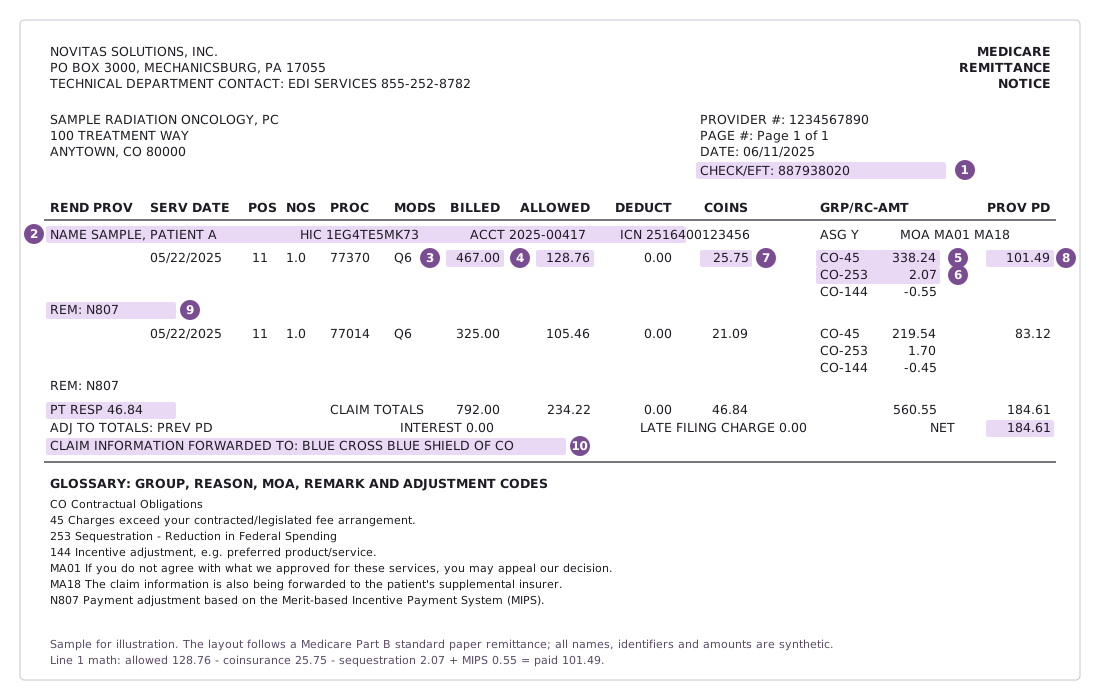
On our annotated Medicare remittance, the patient identifier and the claim control number sit on the same line as the patient’s name, which is where Noridian’s remittance layout puts them.
From HICN to MBI
The HICN was the patient’s (or a spouse’s) Social Security number with a suffix, so a lost or stolen card exposed that Social Security number. CMS replaced it with a randomly generated identifier and mailed new cards. The timeline, from CMS:
| Period | Rule |
|---|---|
| April 1, 2018 to December 31, 2019 | transition; either the HICN or the MBI accepted |
| January 1, 2020 onward | MBI required on claims regardless of the date of service, with exceptions |
The exceptions CMS lists: appeals and related forms, audits, certain adjustments and reports, claim status queries (276) when the earliest date of service is before January 1, 2020, and span-date institutional claims whose “from” date is before December 31, 2019.
The MBI is confidential. CMS asks that it be protected like a Social Security number.
The MBI format
| Position | Type |
|---|---|
| 1 | number, 1 to 9 |
| 2 | letter |
| 3 | letter or number |
| 4 | number |
| 5 | letter |
| 6 | letter or number |
| 7 | number |
| 8 | letter |
| 9 | letter |
| 10 | number |
| 11 | number |
Letters are uppercase and never S, L, O, I, B or Z, so an O is always a zero and an I is always a one. The card prints the MBI in groups with dashes (CMS’s example is 1EG4-TE5-MK73); the dashes are not part of the number and are not entered on claims or in files. Lowercase entries are converted to uppercase by Medicare’s systems. The characters carry no meaning; a spouse’s MBI has nothing in common with the patient’s.
Each person with Medicare has one MBI. It can be reissued if compromised, which is one more reason to re-read the card at every visit.
The ICN
The Internal Control Number is assigned by the MAC when a claim enters its system. On Noridian’s Part B standard paper remittance it is 13 digits: the first two indicate the claim or adjustment type, the next two the year the claim was received or the adjustment was started, and the rest is a sequential number assigned by Julian date. Some MAC documents call it the claim control number (CCN), and in the electronic 835 it is the payer claim control number.
You use it in three places:
- Asking about a claim. The IVR and the portal find a processed claim by ICN faster than by patient and date.
- Reopening or correcting. Noridian requires the ICN for a telephone reopening, and its portal finds the claim to correct by ICN. For payers that accept corrected claims, the original claim number goes in box 22 with frequency code 7 (replacement) or 8 (void), or in loop 2300 REF*F8 on the 837P.
- Appealing. A redetermination request must identify the beneficiary, Medicare number, dates of service and the items in dispute within 120 days of the initial determination (presumed received five days after the notice date). The MAC’s form includes an ICN field, and the ICN is the most reliable way to identify the exact claim.
Worked example
A returning patient’s chart still carries a HICN from 2019. The front desk does not re-scan the card, so the claim for 77427 billed at 240.00 (illustrative) goes out with the HICN in box 1a. The MAC returns it with CARC 16 and RARC N382: patient identifier missing, incomplete or invalid.
The biller runs eligibility, which returns the patient’s MBI, updates the chart, and sends the claim again as a new claim (a rejection for an invalid identifier means the MAC never accepted the original, so there is no ICN to correct). The remittance two weeks later shows the MBI in the MID column, an ICN for the new claim, allowed 180.00, CO-45 60.00, PR-2 36.00 and payment of 144.00.
Three weeks after that the practice realizes the units were wrong on one line. Now there is an ICN, so the fix is a reopening through the portal, not a new claim, and the ICN is what the portal asks for first.
What to do
- Read the card at every visit and store the MBI without dashes. The two most common MBI errors are a letter O for a zero and an old identifier left in the chart.
- Verify eligibility before the visit. The response carries the current MBI, which catches a reissued or mistyped identifier before a claim is built.
- Record the ICN as soon as you work on a claim. Every call, reopening and redetermination goes faster with it.
- Tell a rejection from a denial. An invalid identifier is usually a rejection with no ICN: send a new claim. A processed claim with an ICN: reopen or appeal.
- Denials to recognize: CARC 16 with RARC N382 (patient identifier), and RARC MA130 (claim contains incomplete or invalid information, no appeal rights, submit a new claim). See remark codes.
- Iridium Suite’s real-time eligibility check confirms Medicare coverage before the visit, which is the first chance to catch an outdated identifier.
Related terms
- EOB vs ERA
- Remittance advice remark codes
- Claim adjustment group and reason codes
- CMS-1500 box by box
- Medicare crossover claims
- Timely filing limits
Further reading: CMS: New Medicare Card (MBI); CMS: Understanding the MBI format (PDF); Noridian: Standard Paper Remittance field descriptions; CMS: First level of appeal, redetermination by a Medicare contractor.
Frequently asked
What is a HIC number?
The Health Insurance Claim Number (HICN) was the Medicare beneficiary identifier built from a Social Security number plus a letter suffix. Medicare removed it from cards and replaced it with the Medicare Beneficiary Identifier (MBI). Since January 1, 2020, claims must carry the MBI regardless of the date of service, with a few exceptions such as appeals.
What is the MBI format?
The MBI is 11 characters of numbers and uppercase letters. Positions 2, 5, 8 and 9 are always letters; positions 1, 4, 7, 10 and 11 are always numbers; positions 3 and 6 can be either. The letters S, L, O, I, B and Z are never used. It is printed on the card with dashes, as in 1EG4-TE5-MK73, but the dashes are not entered on claims.
What is an ICN on a Medicare remittance?
The Internal Control Number, also called the claim control number, is the number the Medicare contractor assigns to each claim when it is received. On Noridian's remittance it is 13 digits. You need it to ask about a processed claim, to request a reopening by phone or portal, and to tie a corrected claim or redetermination to the original.
Can I still use the HICN on a Medicare claim?
No. Since January 1, 2020, the MBI is required on claims regardless of the date of service. CMS allows the HICN in a few places, including appeals, audits and certain adjustments, and for claim status queries when the date of service was before January 1, 2020. If the chart has only a HICN, get the MBI from the card or your MAC's lookup tool.